March 5, 2015

March 5

March 5, 2015:  Thursday, Second Week of Lent

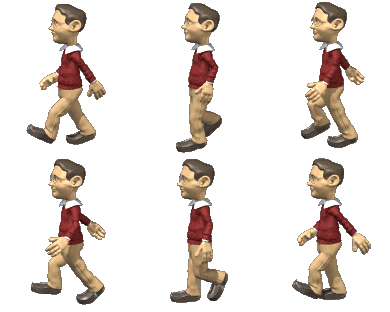
See nine connections between the picture
and today's readings and celebration?
Legend at bottom
Listen
Pope Francis
Homily:  Nobody spoke ill of the rich man; he might have been religious, but his soul was so darkened he couldn't see Lazarus; he just saw his life but didn't realize he'd grown sick with worldliness; he'd lost consciousness of reality.  Worldliness anesthetizes the soul.
The poor are living in our midst, in great difficulty, but worldly hearts don't see it; they can't comprehend others' neediness.  Jesus prayed,  "Keep these disciples from falling into the world."  Worldliness is more than a sin; it's a sinful state of soul.  The rich man turned from God, sick of heart, empty of soul, alone with his selfishness.  The poor man had a name, but the worldly, who think they have everything, lose theirs, but God is still Father to them and waits till the last moment.

Audience:  “The quality of a society is judged by how it treats elderly people and by the place it gives them.”  Many don't make room for the elderly, and even consider them burdens.  It’s a mortal sin to discard our elderly; they're not aliens.   We are them, in though we choose not to think about it.  If we don't look after and respect our elderly, we'll be treated the same way.  A society where the elderly are discarded carries a lethal virus.
Because of the elderly's vulnerability and special needs, they call for special attention and care.  They're a storehouse of wisdom.  The Church has accompanied them with gratitude and affection, making them feel accepted.  We can't accept seeing them abandoned, marginalized; where they're not honoured, there's no future for the young.

To Academy for Life re Assisting the elderly:  People are precious, good in and of themselves, and loved by God.  When life becomes fragile, we must assist and accompany the person in the best way. 
The commandment to honor our parents reminds us of the honor we must show to the elderly.  The wisdom that makes us recognize the value of the elderly also allows us to appreciate the gifts we receive from God and be happy.  The Bible sternly warns those who neglect or mistreat their parents.
Today the logic of utility can take precedence over solidarity and gratitude, even in families.  “Honor” here means to show respect and take care of those who could be left, or "made," to die.  There's no more important duty than safeguarding the human person.  Abandonment is the most serious “illness” of the elderly, and the greatest injustice they can suffer:  don't abandon those who helped you grow when they need help.  Capacity for service to the life and dignity of the sick is the measure of the progress of society.  Respect, protect, love, and serve life, every human life!  Only then will you find justice, development, true freedom, peace, and happiness!
Read
Trust in God; be like a fruit-bearing tree...
(animate)
  • Jer 17:5-10  The one who trusts in people, whose heart turns from God, is like a barren bush.  The one who trusts in the Lord is like a tree beside the waters, bearing fruit despite heat or drought.  God alone tests hearts and rewards everyone according to their deeds.
  • Ps 1:1-4, 6  "Blessed are they who hope in the Lord," those who delight in and meditate on God's law; they're like trees yielding fruit.  But the wicked are like chaff...
  • Lk 16:19-31  Poor Lazarus lay at a rich man's door.  Both died; angels carried Lazarus to Abraham, but the rich man was tormented.  Rich man  / Abraham:  "Take pity; send Lazarus!" / "There's a chasm between us." / "Then send him to my father's house to spare my brothers." / "Let them heed Moses and the prophets." / "But they'd change if one came from the dead." / "Not if they don't heed the law and prophets."
Reflect
    • Creighton:  The only thing that spans the chasms within our tortured hearts is love, not miracles, guilt, obligation, or fear.
    • One Bread One Body:  The heart is so twisted and deceitful that most of us don't notice millions of starving people. If we ever change, it will be through God's Word.  The afternoon of Jesus' resurrection, he practiced what he preached in today's parable:  he opened the hearts of the disciples en route to Emmaus to understanding by interpreting Scripture for them.  Expose your heart to God's Word.
    • Passionist re almsgiving:  “Whoever is kind to the needy honors God.”  'Alms' comes from the Greek for 'pity' or 'mercy'; almsgiving is dispensing mercy.  Almsgiving is prayer because it's “giving to God”; it's fasting because it's sacrificial giving.  It can change us:  once we recognize we can help someone person in need, we experience compassion.  Our Lazaruses can come at undesirable times and be easy to overlook, but we can dispense Christ's compassion!

    • DailyScripture.net:  Rely on God; you won't be disappointed.  God will be your consolation, hope, and joy. / In the gospel, poor, sick Lazarus (="God is my help"), treated with contempt, was raised up.  Those who hold on to what they have lose it, while those who share receive more than they give.  Lazarus hoped in God, but the rich man [sometimes called Dives from the Greek though not named], who didn't see beyond his possessions to others' needs, lost sight of God and became a beggar.
    Apparel legend
    • 'Tree' pin:  Those who trust the Lord are like trees...  (1st reading, psalm)
    • 'Fruit' pin:  ...that bear fruit (1st reading, psalm)
    • 'Girl with heart' pin:  God tests the heart (1st reading)
    • 'Eyeball' tie pin:  The Lord watches the way of the just (psalm)
    • 'Penny pincher' button:  rich man (gospel)
    • 'Dogs' tie:  Dogs licked Lazarus's sores (gospel)
    • 'Angel' pin:  When he died, angels carried him to Abraham's bosom (gospel)
    • Purple in shirt, tie, suspenders:  rich man's garb (gospel), Lent (season)

    March 4, 2015

    March 4

    March 4, 2015:  Wednesday, Second Week of Lent


    • 'Hand' tie pin: Into your hands I commend my spirit; in your hands is my destiny (psalm); the Son will be handed over... (gospel)
    • 'Crucifix' pin:  ...to be crucified (gospel)
    • 'Cups' tie:  "Can you drink from my cup?” (gospel)
    • Purple suspenders:  Lenten season
    Listen

    (with Bishop Friends of the Focolare Movement, AKA Work of Mary):  The unity proper to the Work of Mary is anchored in the Eucharist, which gives it its Christian and ecclesial character and without which, unity would be reduced to the human, psychological, and sociological.  The Eucharist guarantees Christ's centrality, and his Spirit moves us.
    “Because the loaf is one, we, though many, are one body, for we all partake of the one loaf.”  We gather around the Eucharist, the table of the Word and the Bread of Life.  The Bishop is the principle of unity in the Church, but it doesn't happen without the Eucharist.  We bishops offer our lives for the sheep as the Good Shepherd did; we assume a Eucharistic existence.  Conformed to Christ, we become a living Gospel, and Bread broken for the life of many via preaching and witness.  Christ's love urges us to give our life for others, to go out to meet the marginalized and despised.
    Read

    • Jer 18:18-20  “Let's plot against Jeremiah, noting his words to destroy him by his own tongue.”  Heed me, Lord, and listen to my adversaries.  Must good be repaid with evil?  Remember I spoke to you on their behalf to deflect your wrath.
      Can you drink from the chalice...?
      (animate)
    • Ps 31:5-6, 14-16  "Save me, O Lord, in your kindness."  You'll free me from their snare.  Into your hands I commend my spirit.  They're plotting to take my life, but I trust in you.
    • Mt 20:17-28  Jesus to the Twelve, “The Son of Man will be condemned to death, mocked, scourged, crucified, and raised.”  Mother of Zebedee's sons:  “Command that my sons will sit, one at your right and the other at your left, in your kingdom.”  Jesus/James and John:  “Can you drink the chalice I'm going to drink?”/“We can.”/“You will, but sitting at my side is for those my Father prepared for it.”  Jesus, when the others got indignant:  “Don't be like rulers who make their authority felt.  Whoever wishes to be great among you shall be your servant.  The Son of Man came to serve and to give his life as ransom for many.”
    Reflect
    • Creighton:  Jesus flipped the model of leadership:  “To be great, be a servant... The Son came not to be served but to serve”; “The greatest must be your servant.”  Become a servant leader:  sacrifice time, talent, and treasure to lift up those around you.  Stay close to Jesus en route to the cross as others left him out of fear, boredom, or mistrust.  Ask, "What have I done for Christ?  What am I doing for Christ?  What ought I do for Christ?"  (Ignatius of Loyola, Spiritual Exercises, 53)​
    • One Bread One Body:  "Service stations of the cross":  Most have an inner desire to serve, but service can hurt and we also want to set limits.  Will I "drink the cup" of crucified service-slavery?
      St. Casimir
    • Passionist:  It’s not easy to give without hope of return, but unselfish love and service is what Jesus asks of and models for us.  May our Lenten discipline help form us as his disciples of Jesus, giving ourselves in service.  May Jesus Crucified inspire us to be humble, generous, joy-filled servants.
    • DailyScripture.net:  Jeremiah met opposition for speaking God's word, as did Jesus from those who opposed his authority.  Jesus reversed the world's thinking:  to be great, serve others.  In his time, servants had no personal choice, but Jesus' model of servanthood is based on freedom, deciding to put others first and serve them with love.  "For freedom Christ set us free; through love be servants of one another" (Gal 5:1,13).  Jesus said he "came not to be served but to serve."  Can I drink Jesus' cup of sacrificial service and death to self, whether via martyrdom or daily sacrifices of Christian life?  "To serve is to reign with Christ."

    March 3, 2015

    March 3

    March 3, 2015:  Tuesday, Second Week of Lent

    • Tie with red and snowmen:  Though your sins be like scarlet/crimson, they may become white as snow (1st reading)
    • 'Sword' tie pin:  If you refuse and resist, the sword shall consume you (1st reading)
    • 'Scales of justice' pin:  make justice your aim (1st reading)
    • Blue shirt:  wash yourselves clean! (1st reading)
    • White tie pin:  your sins may become white (1st reading)
    • Purple suspenders:  Lenten season
    Listen

    Pope Francis homily
    God prefers “sanctified sinners” (who despite their sins learn to do good) to “fake saints” (more concerned with appearance than doing good).  The 1st reading is an invitation and imperative to conversion:  "Cease to do evil, learn to do good," defending those no one remembers, including the abandoned elderly, children who don't go to school or know how to make the sign of the Cross.  You convert by learning to do right!  You can't have the dry cleaners remove the filth of the heart; remove it by doing, taking the path of doing good:  seek justice, encourage the oppressed, defend the orphan, plead for the widow.  (In Israel orphans and widows were the most needy.)  Go to the wounds and pain of humanity; the good will cleanse your heart.  A cleansed heart is promised God’s forgiveness.  God does not count the sins of those who concretely love their neighbor.  "If you take the path I invite you to, though your sins be as scarlet, they'll be white as snow."  The Lord forgives everything!  But you must set out on the path of doing good. 
    In today's gospel, Jesus reflects on hypocrites who say the right things but do the opposite, only pretending to convert.  Their heart belongs to the father of lies, not to the Lord; this is fake holiness.  Jesus prefers sinners because they tell the truth about themselves.  A hypocrite never says "Get away from me; I'm a sinner!" like Peter did.  Think about the invitation to conversion, the gift of forgiveness the Lord has for us, and the trap of hypocrisy.
    Read

    • Is 1:10, 16-20  Wash yourselves clean!  Cease doing evil; learn to do good.  Make justice your aim.  Though your sins be like scarlet, they may become white.  If you obey, you'll eat well...
    • Ps 50:8-9, 16bc-17, 21, 23  "To the upright I will show the saving power of God."  Why recite my statutes when you hate discipline?  I'll correct you.  Offer praise as your sacrifice and do right.
    • Mt 23:1-12  Do what the Scribes and Pharisees tell you, not what they do; they don't practice what they preach.  Don't be called ‘Rabbi’ or ‘Master’ or call people ‘Father’; God is the only Father.  Serve; humble yourself and be exalted.
    Roamin' Catholic report for a non-Catholic Christian church recommended for lively worship
    • Order of worship:  Opening song, introduce new members, penitential rite, live excerpt from upcoming kids musical, announcements, sermon, communion, charge and benediction, offering with final song
    • Dress:  casual but not sloppy, including worship leaders
    • Worship space:  smaller (capacity 200?) of the two in the church building
    • Technology:  dedicated team in the back doing sound and lighting and controlling permanent front/center/high big screen (song lyrics except at communion, scenes during kid musical excerpt; all pleasing to eyes and easy to read from the back).  Sound was great (clear, not overpowering); lighting was dramatic as for a concert (IMHO downsizing the assembly's role).
    • Kid musical excerpt, a modern take on half of the Prodigal Son story, was great; it showed kids were engaged, and the sermon picked up on the Prodigal Son.
    • Survey:  Among the announcements was one about a survey they're doing of the congregation; they projected how to access it online and said how to get a paper copy.  I started it today to see what it was like; it was well structured, brief, and had good questions.  I appreciated this because I think we don't encourage feedback from our parishioners or get enough of it.
    • Sermon touched not only on the Prodigal Son but also got into the Vanishing Grace book and spoke about God, us, and art:  Jesus' parables were a sort of art, and we're called to be an artistic expression of the face of Jesus...  (He made good points, but I'm used to more tightly organized content and not used to 20 minutes of preaching in a 75-minute service.)
    • Communion:  we were all invited up, but I respectfully stayed in my seat and prayed for closer Christian unity.  I heard they used 'real' bread (probably unleavened) and appreciate that sign.
    • Surprise:  Non-Catholic Christian services I've attended have been Word-heavy, with Bible readings and long sermons/messages.  Though Sunday morning's service referred to Scripture, especially Lk 15:11-32, but there was actually no Bible reading.  I missed it.
    • Music ministry:  front and center stage (literally), including lead vocalist, acoustic guitar, electric guitar, electric bass, drummer (in drum cage at rear).  Some songs flowed into a spoken prayer over instrumental music; some might think it cheesy, but I thought it worked well.  Singing was stronger than at my parish, but I was surprised it was far from widespread and enthusiastic.  (Musicians changed for the kid musical excerpt:  drums out, sax in.)  Sung:
    PS:  I was playing at Sunday's 5:30pm Mass so was free in the morning.  Thanks to Scott, Jessica, and Joe who were able to come along!
    More Roamin' Catholic reports
    Reflect
      • Creighton:  New parents, priests, and professionals often suffer from the “imposter phenomenon” and feel underqualified.  Many deal with these feelings badly, overcompensating for their insecurity by overwork or avoiding work.  Jesus corrects the Pharisees, who likely fell victim to this, telling them to avoid titles that prop us up but get in the way of our call to serve.  Forget your titles, humble yourself, and drop your self-misperceptions to see yourself as the child of God you are and let your love flow from that.
      • One Bread One Body:  "The deluge of guilt":  Many have unformed or deformed consciences, but reality finally sets in, and guilt can flood them.  When they cry to the Lord, he forgives, frees, and heals them.  Jesus took on our sins and guilt at the Cross so we can be washed from guilt and cleansed from sin.
      • Passionist:  Before we can set things right, we need to seek and offer forgiveness.  Don't give up on those who do you wrong; forgive as God has you.
        St. Katharine Drexel
      • DailyScripture.net:  Isaiah warned the people to listen and submit to God's teaching to do good, not evil; Jesus warned the scribes and Pharisees to teach and serve with humility and sincerity instead of making faith a burden for others.   Respect for God leads to humility and submission.
      Origen reminds teachers/leaders they're disciples/servants first:  "You have one teacher, and you're all brothers...  Whoever ministers with the divine word doesn't put himself forward to be called teacher, for he knows that when he performs well it's Christ within him.  He should only call himself servant...."
      The humble assess themselves realistically.  True humility frees us to be ourselves as God regards us and not fall into despair or pride or put on a facade.   Humility is the foundation of other virtues; it enables us to see as God sees, be teachable, give ourselves to something greater than ourselves, and love and serve willingly and selflessly.  The greatest example of humility is Jesus Christ, who became obedient unto death on a cross.
        • St. Vignal (1 of 50 name variations), abbot

      March 2, 2015

      March 2

      March 2, 2015:  Monday, Second Week of Lent


      • 'Sheep' tie bar:  "We the sheep of your pasture will give thanks..." (psalm)
      • 'Ruler' tie bar:  "The measure you measure will be measured to you." (gospel)
      • White shirt:  Transfiguration clothing (Sunday gospel)
      • 'Jubilee year' button:  Gospel fills us with joy (Cantalamessa homily)
      • Purple in suspenders:  Lenten season
      Listen

      From the Vatican
      Pope Francis homily:  The ability to judge oneself is a Christian virtue, the first step for those who want to be Christian.  We're masters self-justification with alibis to explain away our shortcomings and sins.  It’s easy to blame others, but if we look at what we're capable of doing, we'll feel disgust but then receive peace and health.  When I feel envy and know it's capable of speaking ill of others and assassinating them, it's the wisdom of judging oneself.  If I don't learn this step, I'll never be able to take other steps along the Christian road.
      Judge yourself:  I'm capable of doing bad things.  The roots of sin are in each of us.  Recognize the shame of your sin and the greatness of God's mercy.  "Be merciful as your Father is merciful."  When you accuse yourself first, you're merciful to others:  who am I to judge, if I can do worse things?  "Stop judging and condemning, and you won't be judged and condemned.  Forgive and you'll be forgiven."  May the Lord give us grace to judge ourselves, ask for shame and mercy, and be merciful to others.
      Pope's Angelus:  At the Transfiguration Jesus is on the way to Jerusalem, where the 'Servant of God' prophecies would be fulfilled.  The crowds, facing the prospect Jesus wouldn't liberate them from Roman rule as they thought the Messiah would, abandoned him.  Peter, James and John witness Jesus on a mountain, praying, transfigured, radiant, revealed as perfect icon of the Father in glory.  "Listen to him!"  Listen to and follow the Savior; the journey leads us to happiness.  We too climb the Mount of Transfiguration and stop in contemplation of Jesus' face, to receive the message and translate it into our lives; love can transfigure us.
      Papal preacher Fr. Cantalamessa's homily: Gospel Joy Fills Heart and Life (concluded, from yesterday)
      4. Faith, works and the Spirit:  We don't reduce the Gospel to faith, neglecting works.  The Bible speaks of conversion to those who have already believed.  A child can do nothing to be conceived, but once born, it must use its lungs and suck milk or else the life it received is extinguished.  In the same way, “faith apart from works is dead.”  “Faith renders itself active through love”:  we're not saved by good works, but we're not saved without good works.
      Evangelii Gaudium reflects the faith/works synthesis:  the gospel says no to egoism, injustice, idolatry of money and yes to service of others, social commitment, and the poor.  The personal encounter with Jesus becomes the spring for evangelization and sanctification.  The need for commitment doesn't attenuate the promise of joy but reinforces it.  The grace God offered by sending his Son doesn't leave us alone; it does in and with us what it commands, making us “overjoyed also in tribulation.”  The Holy Spirit “helps us in our weakness”; he's our great resource.  The promised joy is the fruit of the Spirit, maintained only through continuous contact with him.
      Human breathing takes place in two phases:  inspiration and expiration.  It's a good symbol of what should happen in the spiritual organism:  through prayer, meditation, sacraments, mortification, and silence, we inhale the Spirit; we diffuse the Spirit when we go out towards others to proclaim the faith and do works of charity.  The Lenten Season a time of inspiration.  Take deep breaths; fill your soul's lungs with the Spirit, so our breath will have the scent of Christ.
      Read
      • Dn 9:4b-10 “Lord, we've sinned, but compassion and forgiveness are yours!” 
      • Ps 79:8-9, 11, 13 "Lord, do not deal with us according to our sins." O God, help us, deliver us, and pardon our sins; then we'll will give thanks and praise you.
      • Lk 6:36-38 Be merciful like your Father. Stop judging, stop condemning, forgive, and give; the measure with which you measure will be measured out to you. 
      Reflect
        • Creighton:  The gospel gives us a blueprint for loving and generous relationships with others.  It's also the kind of relationship God wants with and for us:  mercy and compassion, not judging or condemnation.  We can only experience the covenant relationship with God we've been promised when we get out of the way. God is love and God is generous!
        • One Bread One Body:  "Permissiveness and compassion":  Today's readings speak of ever-increasing awareness of sin.  Sin results in being brought low.  People who rebel against God will reap sin's harvest, disaster and death; the measure rebels measure will be measured back to them.  A Christian can't encourage a lost sheep to wander into sin rather than the Good Shepherd's loving protection.  Permissiveness can be seen as an act of indifference, the opposite of compassion.  Compassion doesn't judge motivation but doesn't ignore sin's effects; it embraces the lost and stands ready to rescue them from the consequences of its rebellions.
        • Passionist:  "Give....  The measure you measure will be measured to you" is a great standard for a Lenten project.  All day we give and receive greetings, food, talk, right of way on the road, smiles,....  Will I give in good measure?  Will I receive in humble gratitude?  Will my Lent prepare me for God's greatest gift, Jesus' sacrifice on a cross, so that we too might rise? 
        • DailyScripture.net:  Do I pray for mercy and pardon for myself and others who need it?  Do I forgive, or allow resentment to grow?  Daniel was shamefaced before God because he recognized many had been unfaithful.  He acknowledged the sins and pleaded for compassion.  When we're confronted with our sins, we experience guilt and shame.  If we're honest and humble, we'll ask for mercy and forgiveness and turn towards good.
        Jesus, knowing us, said "don't judge lest you be judged":  we judge with mixed motives, impure hearts, and prejudice.  We must be cleansed to discern right judgment with grace and mercy.  Ephrem the Syrian:  "With the judgment you judge shall you be judged is like 'Forgive, and it will be forgiven you.'  One who's judged with justice should forgive with grace, so that when he's judged, he may be forgiven.  It was on account of judges who seek vengeance that he said, 'Don't condemn' (don't seek vengeance for yourselves).  Don't judge from appearances and opinion and then condemn, but admonish and advise.  (Commentary on Tatian's Diatessaron, 6.18B, paraphrased) 
        Treat others as God wishes, with forbearance, mercy, and kindness.  God, good to saint and sinner alike, seeks what's best and teaches us to seek others' good.  Our love must be marked by the kindness God shows us, though it's hard when we can expect nothing in return.  Prayer for those who do us ill breaks the power of revenge and releases the power of love.  God makes it possible for us to love those who cause us grief; God's love conquers all, even our hurts and fears.
          • Universalis:  St. Chad, bishop, abbot, outstanding in humility and simplicity of life.

          March 1, 2015

          2nd Sun. of Lent

          March 1, 2015:  Second Sunday of Lent

          Find 12 connections with today's readings and celebration?
          Legend below

          Listen

          From Ed Bolduc's blog (but new links)
          2. How to respond to new needs?  For baptized Christians who may be in the Church and receive sacraments but still need evangelization, RCIA and other life-filled movements render almost tangible the Church's vivacity and the Holy Spirit's presence and action.
          3. The Gospel fills believers with joy:  Gospel joy is only experienced by establishing an intimate relationship with Jesus.  The Gospel is called euangelion (happy, beautiful, joyful news):  Mark summarizes Jesus' preaching as  “The time is fulfilled, and the kingdom of God is at hand; repent and believe....” but its meaning has been obscured because of the Greek metanoeite ('repent') was translated 'do penance'  instead of “turn your mind around,” be aware of what's happening.  Before Jesus, 'convert' meant “go back,” return to the violated covenant, through renewed observance of the law; it had an ascetic, moral, and penitential meaning:  changing one’s conduct.  Conversion was seen as a condition for salvation.  John the Baptist meant it this way (Lk 3:4-6), but with Jesus the reality changed:  conversion was to leap forward and enter into God's kingdom.
          "Be converted" and "believe" are the same action; be converted by believing!  Conversion and salvation have exchanged places:  no longer: sin, conversion,  salvation (convert and salvation will come), but sin, salvation, conversion (convert because salvation has come).  We're no better or worse than before, but God sent his Son so we might be adopted.  Many parables, such as those of the banquet and lost sheep, confirm this happy proclamation.  The sheep's conversion consisted of the shepherd's bringing it back on his shoulders; the sheep just let itself be carried.  St. Paul: “The gain I had [to be a circumcised observer of the law] I counted as loss for the sake of Christ; I count all as loss because of the worth of knowing Christ, for whose sake I've suffered the loss of all things, and count them as refuse, that I may gain Christ, having righteousness through faith in him, the righteousness of God that depends on faith” (Phil 3:7-9).
          The Gospel is 'good news' and is source of joy because it tells of a God who “so loved the world that he gave his only Son, that whoever believes in him should have eternal life.”  Many remember Jesus’ “To come after me, deny yourself, take up your cross, and follow me” and see the Gospel as suffering and self-denial, not joy, but “follow me” is not just to death on the cross but through death to the resurrection, life, and joy without end!  [continued tomorrow]
          Read

          • Gn 22:1-2, 9a, 10-13, 15-18  God tested Abraham, asking him to sacrifice his only son, Isaac.  As Abraham took the knife, the angel stopped him.  "I know now how devoted you are to God.  I'll bless you abundantly."
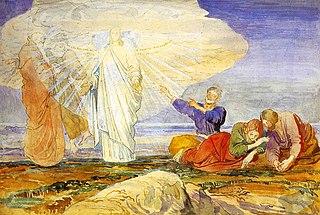
            Transfiguration/ Ivanov
          • Ps 116:10, 15-19  "I will walk before the Lord, in the land of the living."  I believed.  Precious in God's eyes is the death of his faithful.  I'm your servant; you loosed my bonds.  I'll offer you a sacrifice of thanksgiving and call upon your name.
          • Rom 8:31b-34  If God is for us, who can be against us?  How will he who handed his Son over for us not give us everything else?  Who will bring a charge against God’s chosen ones:  God who acquits?  Christ at his right hand interceding for us?
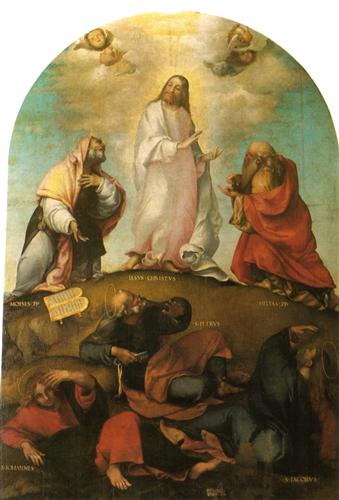
          • Mk 9:2-10  Jesus led Peter, James, and John up a mountain and was transfigured before them.  Elijah and Moses appeared and were conversing with Jesus.  Peter:  “It's good we're here!  Let's make three tents....”  Voice from cloud:  “This is my beloved Son. Listen to him.”  Suddenly they only saw Jesus with them.
          Reflect
            • Creighton:  The Transfiguration is an invitation to transformation.  Only Jesus can transform us, but we must be open, as Abraham was.  What gets in the way?  May I let go of it.
            • One Bread One Body:  "Listening post":  The Lord is the most important person in the world to listen to.  After the Transfiguration, Jesus talked to his apostles about the cross, but they didn't listen till they received the Spirit at Pentecost.  We must listen.
            The Transfiguration of Christ
            (Lotto)
            • Passionist:   The light shining from Jesus reveals his transcendent, divine character, the mountain and cloud recall God’s appearance on Sinai, the figures of lawgiver Moses and prophet Elijah bring the Old Testament and God’s care for Israel into view, and the voice identifies Jesus as “[God's] beloved Son.”  God commands, “Listen to him” as Jesus begins his journey to Jerusalem and the cross, during which he tells his disciples to follow him.  The heart of the Christian message is love, compassion, loving service to the world.
            • DailyScripture.net:  Through the eyes of faith Abraham recognized God's call on his life and hoped in God's promises.  The Lord Jesus reveals his glory in fulfilling his Father's will.  Am I prepared to see God's glory?  The Lord wants to share it with each of us.  Origen re how the transfiguration can change us:   "When he's transfigured, his face shines as the sun that he may be manifested to the children of light who walk honestly as in the day.  He'll shine on them not simply as the sun, but as the sun of righteousness." (paraphrased)  While Jesus was transfigured, Peter, James, and John were asleep.  How much do I miss God's glory and action because I'm spiritually asleep?  May I be awake and alert. "We, with unveiled face, behold the Lord's glory and are being changed into his likeness; this comes from the Lord who is the Spirit" (2 Cor 3:18).
            Apparel legend
            • 'Wood block' tie pin:  Abraham arranged wood on the altar he built (1st reading)
            • 'Hand' tie pin:  Angel:  "Don't lay your hand on the boy" (1st reading)
            • 'Star' tie pin:  "I'll make your descendants as countless as the stars" (1st reading)
            • 'Walker' tie pin:  "I'll walk before the Lord" (psalm)
            • 'Eyeball' tie pin:  Precious in the Lord's eyes is the death of his faithful (psalm)
            • 'Phone' tie bar:  I'll 'call' on the Lord's name (psalm)
            • 'Scales of justice' pin:  If God acquits, who will condemn? (2nd reading)
            • 'Mountain' pin:  Jesus took Peter, James, and John to a mountain (gospel)
            • White shirt:  Jesus' clothes became dazzling white (gospel)
            • 'Cloud' tie:  A cloud came and from it a voice (gospel)
            • 'Jubilee year' button:  Gospel fills us with joy (Cantalamessa homily)
            • Purple suspenders:  Lenten season