March 26, 2015

March 26

March 26, 2015:  Thursday, Fifth Week of Lent


  • NEW Senate seal (with scroll) pin:  God's covenant with Abraham (1st reading, psalm)
  • 'Olympics' pin:  I am making you the father of a host of nations (1st reading)
  • 'Kings' tie:  Kings shall stem from you (1st reading)
  • 'Stone' tie pin:  They picked up stones to throw at him (gospel)
  • Purple suspenders:  Lenten season
Listen

Pope Francis homily:  Meeting Jesus brings joy
Old Abraham believes and opens to hope and is full of consolation.  Jesus reminds the doctors of the law that Abraham rejoiced.  They didn't understand the joy of promise, faith, hope, and the covenant.  Abraham could rejoice because he had faith; they'd lost it.  The "law doctors" even lost the law, since its center is love for God and neighbor!  They only had a system of doctrines, a world without love, faith, hope, trust, or God.  Maybe they doctors could have fun, but with fear, not joy.  Their heart was petrified.  Without joy you're not a true believer.  Pray for the grace to rejoice in hope...

Read
  • Gn 17:3-9  God to Abram:  “I am making you the father of nations.  Kings shall stem from you.  I will maintain my covenant with you and your descendants forever, to be your God.  I will give you the whole land of Canaan.  You must keep my covenant throughout the ages.”
  • Ps 105:4-9  "The Lord remembers his covenant for ever."  Look to and serve the Lord, our God.  You, his servants, his chosen, recall his wondrous deeds!
  • Jn 8:51-59  Jesus / Jews:  “Whoever keeps my word won't see death.” / “You're possessed.  Abraham and the prophets died; are you greater?” / “God my Father glorifies me.  I know him and keep his word.” / “You've seen Abraham?” / “Before Abraham, I AM.” / They picked up stones to throw at him, but he left.
    Reflect
      • Creighton:  We're God's chosen; we belong to him!  Is that how we define ourselves?  
        God's covenant with Abraham, referencing Gn 17:1;
        God and Abe link all today's readings
      • Passionist reflection on 5th station on Way of the Cross, “Simon of Cyrene [now Libya] helps Jesus carry the cross.”  Simon was there when Jesus was in need, and soldiers ordered him to help.  Today people are drafted to help others carry their crosses too.  We take up our own crosses when we help others carry theirs.  Like Simon, the opportunity will likely find us first.  May we appreciate those who have been Simons to others and us...
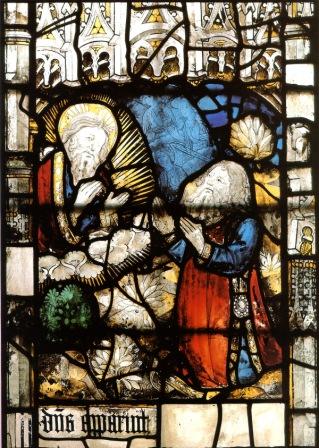
      • DailyScripture.net:  St. Augustine:  "[Jesus] saw another death from which he came to free us:  eternal death, shared with the devil and his angels!  This is the real death; the other kind is only a passage." God offered Abraham an everlasting covenant, and Jesus came to fulfill it so we'd know and be united with God.  Jesus challenged Israel to accept his word as the revelation of God.  He claimed unique knowledge of God as Son of the Father, that the only way to full knowledge of God is through him, and that he uniquely obeys the Father.  In him we see what God wants us to know and be.

      March 25, 2015

      Annunciation

      March 25, 2015:  Annunciation of the Lord

      13 links to today's Bible readings and celebration!
      Legend below
      Listen

      Pope Francis audience
      Today we celebrate the Annunciation, when the Lord illumined and strengthened Mary's faith, as he did later for Joseph, so Jesus could be born in a human family.  The Incarnation is not just Jesus' conception in Mary's womb but also his being welcomed into a true family.  How beautiful this bond, this condescension of God!

      Today many celebrate the Day of Life, and St. John Paul II signed Evangelium vitae, in which the family, the womb of human life, is central.  God blessed us to form a community of love and life and entrusted to us the mission of procreation.  Christian spouses, celebrating the Sacrament of Matrimony, open themselves to this blessing.  The Church is committed to the care of the family, as God's gift for her own life, in good times and bad: the bond between Church and family is sacred.  Mother Church never abandons the family, even when it's disheartened, wounded, and mortified; it'll do everything to seek to heal it, to invite it to conversion, and to reconcile it with the Lord.
      The Church needs much prayer to fulfill this mission, prayer full of love for the family and for life, prayer that knows how to rejoice with those who rejoice and suffer with those who suffer.  Pray for October's Synod on the family, animated by the Good Shepherd's compassion, especially for the troubled and abandoned, so we can be ever more committed and united in witness of God's love and mercy for all families:
      Jesus, Mary and Joseph, in whom we contemplate the splendor of true love, we confidently turn to you.  Holy Family of Nazareth, make our families places of communion and cenacles of prayer, schools of the Gospel, and little domestic Churches.  May they never more experience violence, isolation, or division.  May anyone who was wounded or scandalized experience consolation and healing.  May the upcoming Synod reawaken an awareness of the family's sacredness, inviolability, and beauty.  Amen.
      Read
      • Is 7:10-14; 8:10  Lord / Ahaz:  "Ask for a sign!" / “No; I won't test God.”  Isaiah:  "The Lord will give you this sign:  the virgin shall bear a son, Emmanuel, 'God with us!'"
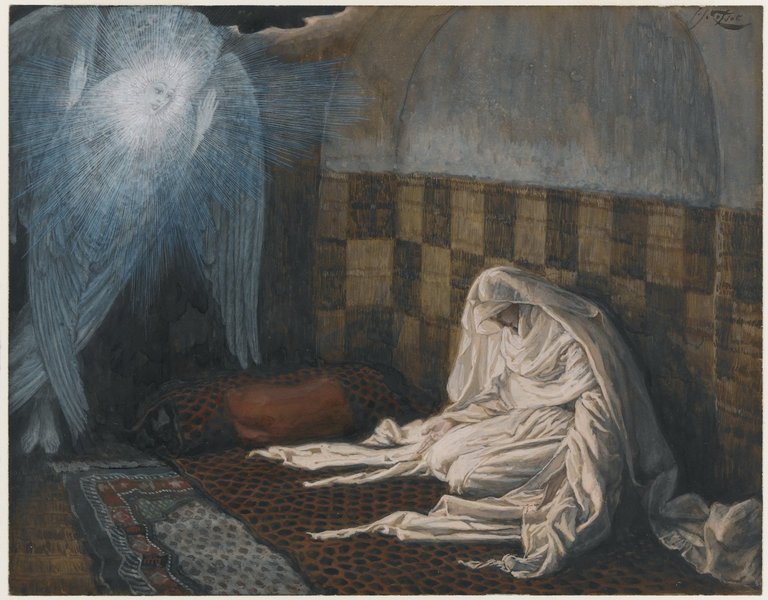
        The Annunciation/ Tissot
      • Ps 40:7-11  "Here I am, Lord; I come to do your will."  You wanted obedience, not sacrifice.  I delight in doing your will.  I announced your justice, faithfulness, kindness, and truth.
      • Heb 10:4-10  Bull/goat blood doesn't take away sins.  He says, “You didn't want sacrifices,” then, “I come to do your will,” taking away the first to establish the second.  We've been consecrated through the offering of the Body of Jesus.
      • Lk 1:26-38  God sent Gabriel to Mary betrothed to Joseph:  “Fear not; you'll bear a great son, Jesus, Son of the Most High, to rule forever.” / “How?” / “The Holy Spirit will come upon you....  'Barren' Elizabeth has also conceived; nothing will be impossible for God.” / “OK; I'm the Lord's handmaid.”
      Reflect
      • Poem:  Annunciation, by Denise Levertov  (Link includes the last 18 lines, usually omitted.)
      • Creighton: Today we celebrate God's becoming human, God's in-breaking into our world.  Our humanity with its limitations, our desire for God, and our capacity to love and forgive put us in solidarity with Christ and God.  The dynamic solidarity catches us up in God’s plan, precipitated by Mary in the event we now celebrate.
      • One Bread One Body:  "Inconceivable conception":  How shocking that God would became human!  More so than seeing a loved one as a bug.  May I respond by living a radically new life of love....
        Study for the Annunciation/ Tanner
      • Passionist:  When Mary said yes, her life was irrevocably and unpredictably changed.  What would she tell Joseph and her family and friends?  How could she raise the Son of God?  How did she pray?  Ask for her inspiration and guidance to overcome fear of the future, find deeper faith, and provide my family with the nurturing love she showed hers.
      • DailyScripture.net:  As Eve was mother of all humanity doomed to sin, Mary became mother of the new Adam who fathered a new humanity by his grace.  Her child fulfilled God's promises:  great, Son of the Most High, King, Jesus ("the Lord saves").  Her first response ("How can this be...?") was of wonderment, not skepticism.  She trusted that what God said would be fulfilled and was willing and eager to do God's will.  God gives us grace and expects us to respond with the same willingness, obedience, and trust as she did.  Do I yield to grace, or resist?
      • Universalis:  We celebrate Mary's "yes;" she could have in her freedom said no.  When the Almighty wants something done, he asks one of his poor, weak creatures—and gives us strength to make the right choice and follow through.  I'm unique and have a unique purpose....
      Dress legend
      • "Happy birthday, Jesus" pin [it could have been any sign]:  "Ahaz, ask for a sign" (1st reading) [today's tie trumped my 'signs' tie]; Annunciation led to Jesus' birth (gospel)
        • 'Hearts' suspenders:  Your law is in my heart (psalm)
        • 'Blood drop' pin:  Bull or goat blood can't take away sins (2nd reading)
        • 'Holy Spirit' chain:  Spirit conceived Jesus (gospel)
        • Blue tie with crowns:  'Blessed Mother blue' (gospel); God will give Jesus the throne of David (gospel)
        • 'Angel,' 'Mary' pins:  Gabriel's annunciation to Mary (gospel)
        • 'Question mark' tie pin:  "How can this be?" (gospel)
        • "No-'L'" pin:  gospel is from Luke's infancy narrative
        • 'Phone' tie bar:  God's 'call' to Mary through Gabriel
        • White shirt:  today's liturgical color

        March 24, 2015

        March 24

        March 24, 2015:  Tuesday, Fifth Week of Lent


        • 'Serpent' tie pin:  Bronze serpent (1st reading)
        • 'Kneeling person' tie bar:  "Lord, hear my prayer" (psalm)
        • 'I ♥ my dad' tie:  Jesus always does what pleases the Father (gospel)
        • Purple shirt and suspenders:  Lenten season

        Listen

        Pope Francis
        Accept God's ways (today's homily):  God offers us salvation so many ways, but we often can't accept them, just as the Israelites objected to the "wretched food" God provided.  We can becoming sullen and grumbly, poisoned by dissatisfaction, wanting salvation on our own terms, but to not accept God’s gift the way it's offered is a sin; it poisons us, depriving us of joy. Jesus solved the problem by taking the poison on himself on the cross. 
         Don't be a tepid halfway Christian showing enthusiasm at the start but becoming dissatisfied on the way; look at the Cross, the serpent, the venom in the Body of Christ, the poison of the world's sins, and be healed.  How many Christians today die in the desert of their sorrow, not accepting God’s way?  Ask for the grace to accept difficult moments, God's way of salvation, the "wretched food," the grace to accept the ways the Lord leads us. 
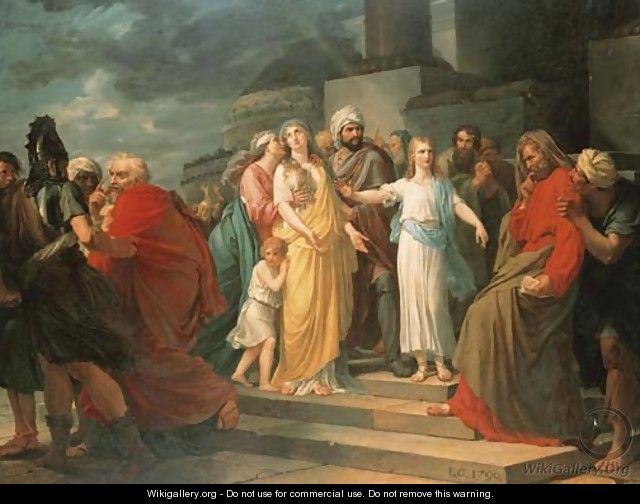
        Corruption vs. mercy (Monday homily):  Susanna, the adulteress, and the poor widow represent allegorical figures of the Church:  holy, sinning, and needy.  Evil, corrupt judges condemned them all.

        The scribes and Pharisees who took the adulteress to Jesus were corrupted by rigidity; they thought themselves pure from observing the law but didn't know mercy.  Rigidity leads one live a double life:  condemning the women but seeking them out for fun; Jesus called them hypocrites.  Those in the Church who judge and condemn others have double standards too.  The lustful elders/judges who tried to blackmail Susanna were corrupted by depravation.  The judge the widow called on to render a just decision was corrupted by greed.  None of them knew mercy; their corruption kept them from understanding one must be merciful.  Justice is found in mercy. 
        The women—the saint, the sinner, and the needy, figures representing the Church—suffer for lack of mercy.  Today we can find ourselves before ‘judges’ who lack mercy, in civilian or church environments.  When God’s people ask for forgiveness, one of these judges may condemn them.  People can exploit us, rob us of hope, punish sinners for sins they themselves conceal; this is lack of mercy.  "Neither do I condemn you" is one of the most beautiful scripture passages because it's full of mercy.
        Read
        Nm 21:4-9  The children of Israel complained, “Why did you bring us to die in this desert with its wretched food?!”  In punishment the Lord sent saraph serpents; many died from their bites.  The people told Moses, “We've sinned in complaining.  Pray the Lord to take the serpents away.”  After Moses prayed, the Lord told him, “Mount a saraph; whoever looks at it will live.” He did; it worked.
        • Ps 102:2-3, 16-21  "O Lord, hear my prayer, and let my cry come to you."  The Lord looked down to hear the groaning of the prisoners and release those doomed to die.
        • Jn 8:21-30  Jesus to Pharisees:  “I'm going away.  I don't belong to this world.  If you don't believe I AM, you'll die in your sins.  I say only what the Father taught me.  The one who sent me is with me.  I do what is pleasing to him.”  Many came to believe.
        Reflect

        • Creighton:  In today's gospel Jesus shows great confidence in his mission.  May God give us courage, conviction, and confidence in God's ability to use us.
          Moses and the Brazen Serpent/ Bourdon
        • One Bread One Body: "Food poison?" The Israelites' basic sin was idolatry, and a part of it was their craving for the food of slavery: meat, fish, cucumbers, melons, leeks, onions, garlic grain, figs, grapes, and pomegranates (Nm 11:4-5;20:5); they were disgusted with God's "wretched" food, the miraculously delivered manna. What's my relationship with food?
        • Passionist:  People in Exodus grumbled, mistakenly accusing God of not caring for them.  We must learn to look on Christ crucified, "lifted up," to learn how deeply God cares for us.  A priest visiting the Holy Land bought a crucifix for his parish; Security x-rayed it for explosives.  He thought, if only they knew how explosive the cross really is!
        • DailyScripture.net:  The bronze serpent reminded the people that sin leads to death and repentance leads to God's mercy and healing. The wooden pole points to Jesus' being lifted up on the wooden cross to break the curse of sin and death and win pardon, healing, and life.  To sin literally means to 'miss the mark' (be off-target).  Sin diverts us from God and our true purpose . Sin separates us from the all-seeing, ever present, all-loving, merciful One.  How do I hide or distract myself from God's voice?
        • Universalis:  St. Macartan, bishop, companion of St. Patrick

        March 23, 2015

        March 23

        March 23, 2015:  Monday, Fifth Week of Lent

        See 10 links to today's readings and celebration?
        (Legend below)
        Listen

        Pope Francis Angelus
        In the gospel a group of Jewish Greeks told Philip they want to see Jesus.  Many others were curious to get to know and learn about him.  Many among us also want to see Jesus and are looking for his life-giving message.  Offer them the Gospel, the crucifix, and your witness:  in the Gospel we meet and hear Jesus; through the crucifix we have the sign of his love for us; in being witnesses to Christianity we express our faith in simple gestures of charity.
        East and West:  Before the Mystery of the Holy Spirit, Lenten sermon of papal preacher Fr. Cantalamessa (concluded; continued from yesterday)

        The Spirit of truth and the Spirit of charity:  Renewed attention to Scriptures permits us to verify the complementarity of Eastern and Western pnuematologies from another point of view.  In the New Testament, John emphasizes the “Spirit of truth,” and Paul emphasizes the “Spirit of charity.”  In John the “Spirit of truth” is the Paraclete, and all who worship the Father should worship him “in Spirit and truth”; he leads “to all truth” and “teaches you about everything.”  For Paul, the Spirit “pours love” into our hearts, and the Spirit's fruit is “love, joy, and peace”; love constitutes “the law of the Spirit”; love is the “more excellent way” because it's the greatest gift of the Spirit.

        As with doctrine about Christ, different emphases about the Spirit are maintained in tradition; the East reflects John's perspective more and the West Paul's.  Orthodox pneumatology has placed more emphasis on the Spirit as light; Latin pneumatology has placed more on the Spirit as love.  The diversity is clearest in Basil’s On the Holy Spirit the Spirit is “intelligible light” but love plays no role, while in St. Augustine’s On the Trinity, the Spirit is love but light plays no role.

        Light, with its phenomena of  transfiguration of the person, is the most consistent element of the mysticism of the Spirit in the East:  “Come, true light!” begins a prayer to the Spirit by St. Symeon the New Theologian.  The “Tabor light,” a large part of Eastern spirituality and iconography, is linked to the Spirit.  The Orthodox Divine Office says that at Pentecost, “Thanks to the Spirit, the world received a baptism of light.”

        Augustine reflects that one might feel sad or excluded because he doesn't have all charisms, but if you love, what you have isn't small.  If you love unity, everything someone else has is yours!  Banish envy and all that's mine will be yours!  Envy separates; love unites. Only the eye sees, but it sees for the hand, foot, and all other members; and the hand acts not only for itself but for the eye.  Charity is the “more excellent way” because  it makes me love the body of Christ, the community I live in, and because of unity, all charisms are mine.  Charity multiples the charisms, so the gifts of one belong to all.  It makes Christ, not ourselves, the center, so we want not “to live for oneself but for the Lord.”  Applied to the relationship between East and West, the principle points to looking at the charism each has that's different from the other not as error or threat but as treasure for all.  Applied to our daily relationships, the principle helps us overcome feelings of frustration, rivalry, and jealousy and bear the fruit of the Spirit.  “Blessed that servant who doesn't pride himself [and rejoice] in the good the Lord says and works through him more than the good he says and works through another” (Francis of Assisi).  May the Spirit help us walk on this demanding path that leads to love, joy, and peace.

        Read 
        • Dn 13:1-19, 15-17, 19-30, 33-62  Two wicked elders lusted for Susanna, hurried to her when she was alone bathing, and threatened to testify against her if she didn't lie with them.  She shrieked, people rushed in and heard and believed the accusation, condemned her, she cried to God, and God stirred Daniel:  “Don't condemn her without examination or evidence.  Return to court; they testified falsely.”  All returned.  “Separate the two.”  He asked each what tree she was under, their answers differed, the assembly put them to death, sparing Susanna's innocent blood.
        • Ps 23:1-6  "Even though I walk in the dark valley I fear no evil; for you are at my side."  The Lord is my shepherd; he gives me repose, guides me, gives me courage...  Only goodness and kindness follow me, and I'll dwell with the Lord.
        • Jn 8:1-11  The scribes and Pharisees brought Jesus a woman caught in adultery:  Moses commanded us to stone such women.  What do you say?”  Jesus wrote on the ground with his finger, but when they persisted, he said, “Let the one without sin be the first to throw a stone” and kept writing; they went away.  Once he was alone with her:  Has no one condemned you?” / “No one.” / “Neither do I.  Go, and sin no more.”
        Reflect
          • Creighton:  Today's 2 stories of women accused of adultery invite us to consider God's mercy for those the innocent and vulnerable.  Both are also about how religious leaders corrupted the social system to protect the innocent.  The elders were not only licentious; they were so jealous and unjust as to stop at nothing to destroy innocent Susanna; flaunting God's compassion and truth, they acted as gods by trying to determine who will live.  In the gospel, the woman was the pawn of religious leaders trying to trap a rival rabbi teaching love and mercy.  The leaders don't worship God; those who honor and love God must be loving and honest because God is and God cares.  To be just requires compassionate mercy; to be merciful we must act justly. 
            Christ and the adulterous woman/ Van Lint
          • One Bread One Body:  Susanna chose to remain faithful, even though she'd lose life, reputation, marriage, and family. God saved her life and reputation, saved her family from disgrace, stopped the elders' ongoing sexual abuse and subversion of justice, and transformed a perverted society by stirring Daniel.  May the Spirit stir us up and transform our culture of death into one of life and love.
          • Passionist:  I threw stones at myself till I realized Jesus is a real person who died for me and who loves me despite my failings.  I now hear him tell me, “Neither do I condemn you.  Go and sin no more.”
          • DailyScripture.net:  When accusations are brought against you, how do you respond and where do you turn for help? Susanna turned to the Lord. / The word for "writing" used in the Gospel (Jesus writing on the sand...) literally means "to write down a record against someone."  Was he writing down a list of the accusers' sins? The scribes wanted to condemn the woman, but Jesus forgave and restored her.
          Dress legend
          • 'Eyeball' tie pin:  The wicked elders wouldn't allow their eyes to look to heaven (1st reading)
          • 'Tree' pin:  wicked elders' testimonies differed re tree identity (1st reading) 
          • 'Kneeling person' tie bar:  Susanna's prayer (1st reading)
          • 'Blood drop' pin:  Innocent blood was spared (1st reading)
          • 'Sheep' tie bar:  The Lord is my Shepherd (psalm)
          • 'Cups' tie:  My cup runneth over (psalm)
          • 'Stone' tie pin:  "Let him without sin cast the first stone" (gospel)
          • 'Girl with heart' pin:  Jesus' merciful love; woman caught in adultery (gospel)

          • Purple suspenders:  Lenten season

          March 22, 2015

          5th Sun. of Lent

          March 22, 2015:  Fifth Sunday of Lent

          Find nine connections with
          today's Bible readings and celebration?
          (Legend below)
          Listen

          Pope Francis to detainees
          I come to bring you the love of Jesus” who came to the world save everyone.  You may feel disappointed, discouraged, and abandoned, but God doesn't forget his children!  He's always at our side, especially in times of trial; he's a Father rich in mercy, always waiting with open arms.  God never tires of showing you the path to him; not even jail bars can separate you from God’s love.  Only sin can separate us, but if we sincerely repent, our sin becomes the place of encounter with him.  Live every day in God’s presence. Don't lose hope in God's mercy and providence.
          Pope Francis to Naples youth
          God is a God of words,  gestures, and silences, knowing us better then we know ourselves. But God can’t speak to us if we're not silent, if we don't silently gaze at the Crucifix.  God created us to be happy, but that doesn't mean everything will be perfect.
          It's hidden euthanasia when when old people are denied medicine, food, or family affection. Solitude is the great poison of the old.  When did you last call or visit your parents? 

          Toward a new synthesis:  Dialogue in the Spirit can iron out difficulties and open up new perspectives; contemporary pneumatology not only reaches agreement on the Filioque but moves towards a fuller synthesis.  The Spirit is not only sent by the Son but is also sent upon the Son; the Son both gives and receives the Spirit.  The transition from one phase to the other is the cross.  The Spirit intervened on Jesus at his birth, his baptism, his self-offering to the Father, and his resurrection; this reciprocity must reflect relationship within the Trinity.  The Spirit's role derives from a Trinitarian relationship through which the Spirit characterizes the relation between Father, source of love, and his beloved Son.

          Christian theologians are converging to recognize reciprocity in the Trinity.  We can call the Spirit “the Spirit of the Father|Son,” but we can't call the Father|Son “the Father|Son of the Spirit”; however, we can call them “the Father|Son in the Spirit”; it is true that we cannot call the Son “the Son of the Spirit” but we can call him “the Son in the Spirit,” using the preposition traditionally used to speak of the Spirit.  As Jesus cried Abba “in the Spirit” on earth, it must be “in the Spirit” that the Son pronounces his eternal Abba in his generation by the Father.  Orthodox theologian Clément anticipated this conclusion in saying “the Son is born of the Father in the Spirit.”

          So we can conceive Trinitarian relationships anew:  Word and Spirit proceed simultaneously from the Father, without chronological or logical precedence.  Just as the nature that constitutes the divine Persons is unique, so too the operation that has its source in the Father that constitutes Father as “Father,” Son as “Son,” and Spirit as “Spirit.”  Son and Spirit can't be seen one before or next to the other but one in the other. Generation and procession are not aspects/results of one unique act.

          Clément speaks of “an eternal anointing” of the Son by the Father through the Spirit, as Irenaeus wrote, "In the name 'Christ' is implied the one who anoints, the one who was anointed, and the anointing itself.  The Father anoints, the Son was anointed in the Spirit who is the unction.”  Basil took this up and Ambrose repeated it.  At first it referred to Jesus’ anointing at his baptism, then as at his Incarnation, then further back.  Justin, Irenaeus, and Origen spoke of a “cosmic anointing,” one the Father confers on the Word in view of creation insofar as “through him, the Father anointed and adorned [arranged] all things.”  Eusebius saw it as at the moment of generation:  “The anointing consists in the very generation of the Word by which the Spirit of the Father passes over into the Son like a divine fragrance.”  Gregory of Nyssa illustrated the anointing of the Word by the Spirit in this eternal generation by the Father, assuming “Christ” (“Anointed One”) belongs to the Son from all eternity.  The oil of gladness represents the power of the Spirit with which God is anointed by God, that is, the Only-begotten is anointed by the Father. . . . The anointed one can't be not-anointed but had to be anointed forever.

          This image of unction adds an active role of the Spirit, so called because he is breathed and breathes, within the Trinity, just as he performs an “active” role outside the Trinity by inspiring Scripture, prophets, saints, etc..  If an active role of the Son toward the Spirit is recognized and expressed by the image of spiration, then there's an active role for the Spirit toward the Son, expressed by the image of anointing.  We can't say the Word is “the Son of the Spirit,” but can say he's “the Anointed One of the Spirit.” (to be continued)

          Read
          • Jer 31:31-34  I'll make a new covenant with Israel and Judah:  I'll write my law on their hearts; I'll be their God, and they my people.  All shall know me, for I'll forgive them and remember their sin no more.

          • Ps 51:3-4, 12-15  "Create a clean heart in me, O God."  Have mercy on me.  Wash me from my guilt; cleanse me of my sin.  Don't take your Spirit from me.  Give me back the joy of your salvation.  I'll teach transgressors your ways, and they'll return to you.

          • Heb 5:7-9  Jesus offered prayers with loud cries and tears to the one who could save him from death.  Though Son, he learned obedience from suffering; and when he was made perfect, he became the source of salvation for all who obey him.

          • Jn 12:20-33  Some Greeks asked Philip, “Sir, we want to see Jesus.”  Philip told Andrew; then they told Jesus, who answered, “The hour has come for the Son to be glorified.  Unless a grain of wheat dies, it remains just wheat; but if it dies, it produces fruit.  Whoever loves his life loses it, but whoever hates it in this world will preserve it.  To serve me, follow me, and where I am you'll be, and the Father will honor you.  “I'm troubled now, but Father, glorify your name.”  Voice from heaven:  “I have and will again.”  Crowd/Jesus:  “An angel has spoken to him.”/“The voice came for your sake.  Now the ruler of this world will be driven out.  When I'm lifted up, I'll draw everyone to myself.”
          Reflect
            • Creighton:  The author Hebrews calls Jesus “high priest” to capture the reality that, like the high priest on the Day of Atonement, Jesus functioned as mediator between God and us, facilitating reconciliation through a sacrifice, in his case, self-sacrifice.  Jesus can function as mediator because he's both divine and human.   He “learned” obedience as a man by obeying the Father's will.  He was “made perfect,” for through his suffering he grew one with people, became a more perfect mediator, and enabled us to be saved.  He's “of the order of Melchizedek” who “without father, mother, ancestry, beginning or end of life, was made to resemble the Son of God.”  The metaphor reminds us Jesus became one of us and helps us connect with him....
            • One Bread One Body:  "The blood of the covenant":  God, wants to love us in a permanent, faithful relationship.  As married couples make a covenant with each other by exchanging vows, so the Lord made covenants with Noah, Abraham, Moses, David, and all his chosen people, but the people broke them all. So God promised to make a new covenant, and we can keep it because God puts it inside us, giving us a new nature capable of love and faithfulness.  Jesus gave us this new nature and new covenant through the cross; we receive it by being baptized into him.  By faith, we live according to our new nature and in the new covenant.
              Walk of faith/ Kinkade
            • Passionist:  In "Walk of faith," Kinkade painted a lush garden with a path down the center; he said he added [Jesus and Peter] to give it fuller life.  In today's gospel Greeks want to see Jesus; they meet one who fulfills Jeremiah's promise of a renewed relationship with God.  He learned obedience from suffering.  He's the seed that fell and died to free us and give us life.  John who revealed Jesus as Gentle Good Shepherd, Bread of Life, Giver of Life to the Dead, and Healer of body and soul now reveals him as Suffering Savior.  Today we see images of suffering:  warfare, bread lines, death camps, children running for their lives....  We also experience pain and suffering in our lives:  death of loved ones, unemployment, illness, aging....  Remember Jesus' suffering and that we need to deal with suffering too.  Even if Jesus wants us to minimize suffering, some is unavoidable.  We're invited to unite ourselves with the Crucified and receive his strength to bring new life and a renewed relationship with God for ourselves and others.  In the neediest of circumstances, we'll see the Suffering Jesus and his love and be empowered for the “walk of faith” through life.
            • DailyScripture.net:  God draws us to himself in peace and friendship.  God established a covenant :  "I'll be your God, and you my people," his people broke it, and God kept sending prophets to draw them back.  Jeremiah offered hope, speaking of a new covenant to wipe away sin and open the way to God's mercy.  The Father sent Jesus for our sake so he could offer the sacrifice to unite us with God and give us life. / After a leader's victory, he was crowned and given a new title (Victor, Savior, Deliverer), robed in royal splendor, and enthroned on high in the sight of all.  Jesus knew the only way to victory was suffering and death.  He described his willingness as his “hour of glory” when he'd fulfill his Father's will.  Jesus saw his death as triumph over sin and darkness.  He used the “grain of wheat” analogy to show how God brings life from death and fruit through suffering.  Seeds on their own are worthless and lifeless, but when destroyed by burial they rise to new life.  To receive life, our fallen nature must be put to death; it occurs in baptism and through daily growth in which the Spirit buries us more deeply so we might rise in God's love and justice.  Death leads to life and allows us to love and serve others....
              • Deogratias, bishop, caring pastoral leader.
              • Nicholas Owen, carpenter, built priest hiding places, martyr. “Nobody can be said to have done more good of all those who labored in the English vineyard.  He saved the lives of hundreds.”
            Dress legend
            • 'Hearts' tie:  I'll write my law on their hearts (1st reading); Create a clean heart in me (psalm)
            • 'Kneeling person' tie bar:  Jesus offered prayers with loud cries and tears (2nd reading)
            • 'Eyeball' tie pin:  “Sir, we want to see Jesus.” (gospel)
            • 'Clock' tie bar:  The hour has come for the Son of Man to be glorified.  (gospel)
            • 'Wheat' pin:  If a grain of wheat falls and dies, it produces much fruit.  (gospel)
            • 'Angel' pin:  Some said, “An angel has spoken to him.” (gospel)
            • 'Ruler' tie bar, 'car' tie pin:  "Now the 'ruler' of this world will be 'driven' out." (gospel) [Ruler better visible here than at top.]
            • Purple shirt:  Lenten season