May 27, 2016

May 27

May 27, 2016:  Friday, 8th week, Ordinary Time

  • 'Hand' tie pin:  "The end is at 'hand.'" (1st reading)
  • Orange suspenders:  "A trial by fire is occurring among you," (1st reading)
  • 'Scales of justice' tie:  "The Lord comes to judge the earth" (psalm)
  • 'Crown' tie bar:  "The Lord is king." (psalm)
  • 'Tree' pin:  All the trees shall exult (psalm); fig tree (gospel)
  • 'Car' tie pin:  Jesus 'drove' the money changers out of the temple area (gospel)
  • 'Heart' tie bar:  Don't doubt in your heart (gospel) [Ouch:  I just discovered that my 'girl with heart' pin fell off before Wednesday's picture!  Unfortunately though a heart is engraved on this tie bar, I don't see it in the snapshot.]
  • Green shirt:  Ordinary Time season
Listen

Pope Francis Amoris Laetitia capsule
We must face migration and its negative effects on family life, expanding the Church's witness to the gospel in this area.  Human mobility can enrich families that migrate and countries that welcome them, but forced migration, because of war, persecution, poverty, or injustice, can put lives at risk, traumatize people, and destabilize families.  We must help families that migrate as well as members who remain behind.  Migration is particularly devastating when it takes place illegally and is supported by human trafficking, or when when it involves women or children forced to endure long periods in temporary facilities and camps, where they can't start an integration process.  Poverty and other family breakdown situations sometimes lead families to sell their children for prostitution or organ trafficking.  The persecution of Christians and minorities is a great trial for the Church and the international community.  We need to help families and Christian communities remain in their native lands,
Dealing with a family member's disability can upset the family's equilibrium, desires, and expectations.  We admire families who lovingly accept a special needs child; they give witness of faithfulness to the gift of life.  They can discover, with us, new approaches, ways of acting, and ways of understanding and identifying with others, by welcoming and caring for the frail human life.  People with disabilities are gifts for their families and opportunities to grow in love, mutual aid, and unity.  When families accept the presence of special needs persons, they'll recognize and ensure the quality and value of every human life.  This will promote care and services on behalf of these disadvantaged persons and will encourage people to draw near them and provide affection.  Dedication to and concern for migrants and persons with special needs is a sign of the Spirit.  Both situations test our commitment to show mercy in welcoming others and to help the vulnerable.  (II:46-47)
Read
  • 1 Pt 4:7-13  The end is near; be serious so you can pray.  Love one another intensely.  Be hospitable without complaining.  Serve with God-given strength.  Preach with God's words.  You're being tried, but rejoice that you share Christ's sufferings.
  • Ps 96:10-13  "The Lord comes to judge the earth."  The Lord is king.  He made the world and governs with equity.  Rejoice!
  • Mk 11:11-26  Jesus, hungry, saw the tree had no figs, cursed it.  He entered the temple area, drove out sellers, buyers, and money changers:  My house shall be called a house of prayer, but you've made it a robbers' den.”  The chief priests wanted to kill him but feared him because the crowd was astonished at his teaching.  Jesus, when they saw the withered tree:  “Have faith in God.  When you pray, believe you'll receive and you will.  Forgive, and your Father will forgive you.”
Reflect
      Cursing the fig tree
      (Byzantine icon)
    • Creighton:  First the disciples heard Jesus curse a fig tree for not having any fruit, even though it wasn't in season; then they saw him angrily overturn tables in the temple.  Jesus wants them to know of his identity, authority, and power.  He chose us and appointed us to bear lasting fruit.  He looks for figs and is disappointed to find none; he didn't see any 'fruit' (good works) in the temple area either.  We'll wither if we reject his teachings.  We must put faith in God and pray believing we'll receive what we ask for.  God always keeps his promises and answers our prayers; nothing is impossible with him.  Prayer purifies or cleanses our heart and can remove guilt.  Jesus wants us to forgive and love like the Father.  "Love covers a multitude of sins."  “Since love grows within us, so beauty grows, for love is the soul's beauty” (Augustine).  God can turn our unforgiveness into love.  What do I need to surrender and entrust to the Lord?
    • One Bread, One Body:  "When your world falls apart," love one another, trust God, don't be perturbed, remain calm, pray, forgive, serve one another, don't be surprised you're being tried, and rejoice in sharing Christ's sufferings.  We can because of our personal relationship with Jesus. When we surrender our lives to him, we know nothing can separate us from his love."
      Christ cleansing the temple/ Mei
      More art
    • Passionist:  “Let your love for one another be intense....  Be hospitable to one another....  As each one has received a gift, use it to serve one another as good stewards of God’s grace.”  What are your gifts, and how do you share them in serving others?
    • DailyScripture.net:  "Have faith in God":  Fig trees were an important source of food; a decaying tree was linked with spiritual decay.  The unfruitful tree symbolized Israel's unresponsiveness to God.  The languishing tree signified the desolation of Israel due to her unfaithfulness to God.  The history of Israel is a preparation for the Messiah's coming.  Jesus' cursing of a fig tree is a prophetic action against the faithlessness of those reject him.  Faith must be nourished with the Word and rooted in love to be fruitful.  Jesus cleansed the temple of those using it to exploit worshipers.  Money changers charged unfair prices to the poor; their 'robbery' dishonored God and was unjust toward others.  Then Jesus exhorts his disciples to have faith and pray with faith.  "To remove mountains" meant "to remove difficulties."  If we pray with faith, God will help us overcome obstacles.   If we want God to hear us, we must forgive those who wrong us....

    May 26, 2016

    Philip Neri

    May 26, 2016:  St. Philip Neri, Priest

    • White shirt:  Long for pure spiritual milk (1st reading)
    • 'Stone' tie pin:  Come to him, a living stone... and, like living stones, be built into a spiritual house... (1st reading)
    • 'Lights' tie:  God called you out of darkness into his wonderful light (1st reading)
    • 'Sheep' tie bar:  We're the flock the Lord tends (psalm)
    • 'Eyeball' pin:  Blind beggar Bartimaeus received his sight (gospel)
    • 'Phone' tie bar:  Jesus stopped and said, “Call him.” (gospel)
    • Green suspenders:  Ordinary Time season
    Listen

    Pope Francis homily
    [We don't celebrate the Most Holy Body and Blood of Christ till this Sunday, but since it's celebrated today in the Vatican (and many other places :-), his homily is for that solemnity.]
    "Do this in remembrance of me."  Paul recalls this command of Jesus in his account of the institution of the Eucharist; it's the oldest testimony we have to Jesus' words at the Last Supper.  “Do this,”  i.e. take bread and the chalice, give thanks, and share.  Jesus commands us to repeat the action by which he instituted the memorial of his own Pasch and gives us his Body and Blood.  The “doing” always has Jesus as its subject but is made real through our hands anointed by the Spirit.  On a previous occasion he asked his disciples to “do” it, in obedience to his Father.  Jesus says to the disciples in front of the crowds:  “Give them something to eat yourselves.”  Jesus blesses and breaks the loaves and provides food to satisfy the crowd, but the disciples offer him the loaves and fish.  Jesus wanted it this way: that, instead of sending the crowd away, the disciples would put at his disposal what little they had.  And the pieces of bread, broken by Jesus, pass into the hands of the disciples, who distribute them; the disciples are “doing” with Jesus, giving them something to eat.  Christ wants to give himself for the salvation of all, but it needs to happen through our offering what we have, receiving bread broken by Jesus, and giving it to all.
    'Breaking' explains “Do this in remembrance of me”:  Jesus, broken for us, asks us to give ourselves, to break ourselves, for others.  “Breaking bread” became the sign for recognizing Christ and Christians.  The Emmaus disciples knew him “in the breaking of the bread.”  The first Jerusalem community “held steadfastly… to the breaking of the bread.”  From the outset the Eucharist becomes the Church's center and life pattern.  Think too of saints, famous or anonymous, who “broke” themselves, their lives, to give others "something to eat."  Parents, besides the bread they provide at home, have broken their hearts to let their children grow.  Responsible Christians have broken their lives to defend human dignity.  They find strength to do this in the Eucharist, in the power of the Risen Lord’s love.  May we give food to the crowds of today, breaking open our faith and lives as a sign of Christ’s love for everyone. 
    Read

    • 1 Pt 2:2-5, 9-12  Come to him, a living stone precious in God's sight, and, like living stones, be built into a spiritual house to be a holy priesthood to offer sacrifices acceptable to God.  You're a chosen race, a holy nation, so that you may announce the praises of him who called you out of darkness into his light.  Once you were no people; now you're God’s people.  You hadn't received mercy; now you have.  Maintain good conduct, so people may observe your good works and glorify God.
    • Ps 100:2-5  "Come with joy into the presence of the Lord."  Give him thanks; serve him with gladness.  Know the Lord God made us, and we're his people.  The Lord is good, kind, and faithful forever.
    • Mk 10:46-52  When blind beggar Bartimaeus heard Jesus was passing by, he cried out, “Jesus, son of David, have pity on me,”  even as many told him to shut up.  Jesus asked him, “What do you want me to do for you?” / “I want to see.” / “Go; your faith has saved you.”  He received his sight and followed him.
    Reflect
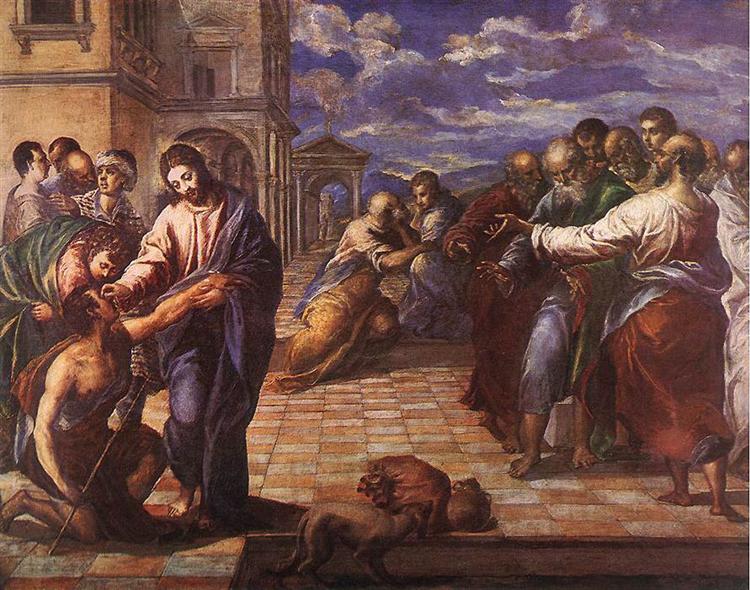
      • Creighton:  When the crowd urges Bartimaeus forward, he abandons his cloak.  For Jews the cloak was almost a house and identity, protection, and power.  He jumps up, goes to Jesus, asks for sight, then is healed and sent on his way.  Once he sees, he goes on without his cloak, and all it means, to follow Jesus.  Later in Mark, similarly, at Gethsemane a nameless young man followed Jesus wearing only a linen cloth.  They caught hold of him, but he left the cloth with them and ran away naked; he reappears at the tomb on Easter morning.  If we believe we “see” who Jesus is and what he's about, are we willing to abandon our security and power, all that gives us identity and security and follow Christ empty of ourselves to be ready to enter his risen life?
        Christ healing the blind man/ El Greco
      • One Bread, One Body:  "If anyone thirsts...":  To receive the Spirit, we must thirst.  Thirst is one of the strongest human desires; think of nursing babies' thirst.  "Be as eager for milk as newborn babies, pure milk of the Spirit to make you grow unto salvation."  We can be this thirsty because the Lord is at work.  The Lord has called you to stifle desires of the flesh and thirst for the things of the Spirit.  Pray for a greater thirst.
      • Passionist:  When Jesus asks Bartimaeus, “What do you want me to do for you?”, Bartimaeus replies “Have pity on me,” refusing to let the crowd quiet him, and Jesus hears him.  Some suggest the “cloak” identified legitimate beggars, but whatever it was, he threw off his old self to go to Jesus.  Jesus asks us too, “What do you want me to do for you?”  In receiving his sight, Bartimaeus started to follow Jesus and can rejoin the community that sat him on the roadside to beg; his identity shifts from beggar to disciple.  What do I deeply want?
        St. Philip Neri/ Guercino
      • DailyScripture.net:  "What do you want me to do for you?"  Bartimaeus was determined to get near the one who could meet his need.  He'd heard of Jesus and his healings but hadn't had a way to contact him.  It took "guts" and persistence for him to get his attention.  The crowd was likely annoyed because he was disturbing their peace and interrupting Jesus' discourse.  He was determined to get Jesus' attention and was persistent.  Jesus showed that acting was more important than talking.  Jesus was ready not only to empathize with the blind man's suffering and to relieve it.  Jesus commends him for his eyes of faith.  Do I recognize my need for God's healing?  Do I seek him out with persistence and trust his goodness and mercy?
      St. Philip Neri
      • Pope Francis:  Philip Neri was a renowned pastor and confessor who had special care for poor children, founding for them a school and a college.  Thanks to his apostolate, commitment to salvation of souls returned to be a Church priority; the Church recovered its understanding that pastors have to be with their people to guide and support their faith.  He's a luminous model of the Church's mission.  The Congregation of the Oratory is the first example of secular priests living a communal life....

      May 25, 2016

      May 25

      May 25, 2016:  Wednesday, 8th week, Ordinary Time

      See 13 connections with today?
      Legend below
      In the parable of the unjust judge and the widow, Jesus tells us even an unscrupulous judge finally renders justice to the persistent poor woman; he encourages us to persevere in prayer to our just and loving Father and assures us that God will hear our prayers and answer them without delay.  Jesus himself prayed constantly.  His prayer in the Garden of Gethsemane teaches us to present our petitions with complete trust in Father’s will.  The parable ends with a pointed question:  “When the Son of Man comes, will he find faith on earth”?  Perseverance in prayer keeps our faith alive and strong.  In prayer we experience the compassion of God who, like a Father filled with love and mercy, is ever ready to come to his children's aid.  More
      • 1 Pt 1:18-25  You were ransomed from your futile conduct with the Blood of Christ.  He was revealed for you who through him believe in God, so that your faith and hope are in God.  Since you've purified yourselves by obedience to the truth, love one another from a pure heart.  You've been born anew from imperishable seed, the living word of God:  “All flesh is like grass that withers, but the Lord's word remains forever.”
      • Ps 147:12-15, 19-20  "Praise the Lord, Jerusalem."  He has strengthened your gates, blessed your children, granted you peace, filled you with wheat, and proclaimed his word to you alone.
      • Mk 10:32-45  Jesus' disciples were amazed.  He told them the Son of man would be handed over, mocked, and killed, then would rise.  When James and John asked him that in his glory they could sit beside him, he asked, “Can you drink my chalice or be baptized with my baptism?” /  “Yes!” /  “Then you will, but the seats aren't mine to give.”  When the others became indignant at James and John, Jesus told them, “Those recognized as the Gentiles' rulers lord it over them and make their authority felt, but whoever wishes to be great among you will be your servant.  The Son of Man came to serve and give his life, not to be served.”
      Reflect
        • Creighton:  What are the attachments in our lives?  Some may be in line with God’s will, such as dedication to family, but many are barriers to hearing and living God's will.  We've been saved by Christ, not things of the world.  Attachment to things is foolish in light of our redemption by God's love through the sacrifice of Jesus.  We must love one another from a pure heart.  Things of the world will wither.  The gospel speaks of the attachment to seeking to be first.  Those wishing to be first will be the slave of all.
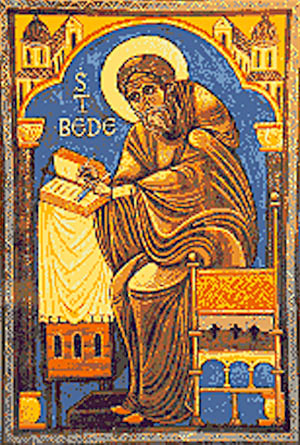
          St. Bede the Venerable
        • One Bread, One Body:  "Is your love genuine?"  Most would answer yes.  Do you believe your family and friends love you?  Early in life, most answer yes, but over time we may conclude that the "love" of some has not been genuine, and perhaps our love for others hasn't been either.  Genuine love is preceded by being purified through obedience to the truth and is based on faith, virtue, discernment, self-control, perseverance, piety, and care for others.  It's humanly impossible but always accessible by God's grace....
        • Passionist:  Pope Francis encourages us to move to the periphery and serve there.  Jesus reminds us that princes of this world use power to dominate, but Jesus' followers shouldn't....
        • DailyScripture.net:  "Can you drink the cup I drink?"  The apostles were distressed at Jesus' prediction of suffering, fearing similar fates.  "Son of Man" was a common title for the Messiah.  Isaiah foretold God wanted the "Suffering Servant" to atone for sins death; Jesus paid the price with his blood, freeing us from slavery to sin and fear of death; he defeated death through his resurrection.
        Jesus wedded authority with service and sacrifice.  Authority without love is brutish and self-serving.  His 'cup' involved crucifixion.  What's ours?  Suffering, martyrdom, life's daily sacrifices and struggles?... 
          Dress legend
          • Silver- and gold-colored accessories:  You weren't ransomed with perishable things like silver and gold... (1st reading)
          • 'Blood drop' pin:  ...but with the Blood of Christ... (1st reading)
          • 'Lamb' tie bar:  ...as of an unblemished Lamb. (1st reading)
          • 'Girl with heart' pin:  Love one another from a pure heart (1st reading)
          • Green shirt:  "All flesh is like grass" (1st reading); Ordinary Time season
          • 'Children' pin:  The Lord has blessed your children,... (psalm)
          • 'Peace sign' tie bar:  ...granted you peace,... (psalm)
          • 'Wheat' pin:  ...and filled you with the best of wheat. (psalm)
          • 'Hand' tie pin:  The Son of Man will be 'hand'ed over... (gospel)
          • '?' tie pin:  “What do you wish me to do for you?” (gospel)
          • 'Cups' tie:  "Can you drink the chalice I drink?... You will." (gospel)
          • 'Ruler' tie bar:  "Those recognized as rulers make their authority felt." (gospel)
          Special greetings to and prayers for St. Bede the Venerable parish and school!

          May 24, 2016

          May 24

          May 24, 2016:  Tuesday, 8th week, Ordinary Time


          • 'Holy Spirit' chain:  Spirit of Christ, Holy Spirit (1st reading)
          • 'Olympics' tie pin:  All the ends of the earth have seen God's salvation (psalm)
          • 'Hand' tie pin:  The Lord's right hand has won victory (psalm)
          • 'Music' tie:  Sing to the Lord a new song (psalm)
          • 'Abacus' pin:  Those who give up for Jesus' sake will receive 100 times more (gospel)
          • Green shirt:  Ordinary Time season

          Listen

          Pope Francis homily
          You can't buy holiness or earn it by human strength.  No; you only attain it through courage, hope, grace, and conversion.  From 1 Peter, a small treatise on holiness, holiness is walking in God's presence without reproach.  It's a journey; you can't buy or sell it or give it away.  It's a journey to God I must make; no one else can do it for me.  I can pray for you to be holy, but you're the one who have to work towards holiness.  Walk in God's presence.  Everyday holiness can be “anonymous.” 
          Courage:  The path to holiness takes courage.  Jesus’ Kingdom of Heaven is for those who have the courage to go forward.
          Hope:  Courage is generated by hope.  Courage hopes in an encounter with Jesus.  Read Heb 11; it beautifully recounts the journey of those God first called:  Abraham went out without knowing where he was going, but with hope.
          Grace:  "Put all your hope in that grace."  Holiness is a grace. Being good, being saintly, progressing daily in Christian life is a grace of God we must ask for.  We must make the journey with courage, hope, and the willingness to receive this grace.
          Conversion, continuous effort towards cleansing the heart, is also important:  not beating yourself up for committing wrong, but small conversions.  Don't speak ill of others.  If you want to criticize a neighbor or workmate, bite your tongue; it'll swell, but your spirit will be holier.  Nothing grand.  The path to holiness is simple.  Always advance with fortitude; don't go back.
          Read
          • 1 Pt 1:10-16  Gird your mind's loins, live soberly, set your hopes on grace, and be holy in every aspect of your conduct.
          • Ps 98:1, 2-4  "The Lord has made known his salvation."  He has remembered his kindness and his faithfulness.  Sing joyfully to the Lord!
          • Mk 10:28-31  Anyone who has given things up for my sake and the Gospel's will receive much more now:  houses, brothers, sisters, mothers, and children and lands, with persecutions, and eternal life.  Many of the first will be last, and the last first.
          Reflect
            • Creighton:  Today's readings focus on sacrifice and giving oneself to Christ.  There are temporarily pleasurable things inconsistent with following Christ, and we humans can fall into them, but Christ forgives us if we ask and try to do better.  The readings call us to find the right kind of joy:  helping others, maintaining good relationships even when challenging, reflecting on the beauty of God’s creation....
            • One Bread, One Body:  "The battle of desires":  Satan tries to pressure and manipulate us through our desires.  We must lay aside our former way of life and old self and "put on Christ and make no provision for the desires of the flesh."  "Those who belong to Christ Jesus have crucified their flesh...."  May we hunger and thirst for righteousness, seeking God's kingdom and way.... 
            • Passionist:  "Leaving and following Jesus":  We must leave all, trimming away whatever detracts from being a productive disciple.  Scripture speaks 76 times of following Jesus; 'follow' is ἀκολουθέω, from 'on the road.'  Discipleship is accompanying Jesus on a journey.  We must keep moving but never out of his sight!
            • DailyScripture.net:  "We've left everything and followed you":  We lose what we keep and gain what we give away.  What we give God returns a hundredfold.  After the rich young man story, Peter wanted to know what his followers would get,  Jesus replied:  a hundredfold now, unending life—and opposition and persecution....
              • Our Lady, Help of Christians:  Mary, Help of Christians was chosen as Patroness of Australasia, but we need her help too.  Her intercession and example indeed help us.
              • St. Aldhelm, abbot, monastery founder, while bishop, writer, poet, songwriter, renowned for learning and sanctity.  He sang and preached in public places to attract people to the faith; too bad his Old English music hasn't survived.  [I can't find his Latin works online either.]
              • Bl. Louis-ZĆ©pherin Moreau, bishop

            May 23, 2016

            May 23

            May 23, 2016:  Monday, 8th week, Ordinary Time

            • 'Clock' tie bar:  Salvation to be revealed in the final time (1st reading); Lord will remember his covenant forever (psalm)
            • Gold-colored accessories:  Your faith is more precious than gold (1st reading)
            • 'Girl with heart' pin:  I'll thank the Lord with all my heart (psalm)
            • Food tie:  he's given food to those who fear him (psalm)
            • 'Eyeball' pin:  Though you haven't seen him, you love and believe in him (1st reading); Jesus looked at the rich man and loved him (gospel)
            • 'Coin' button:  how hard for the rich to enter the Kingdom (gospel)
            • '3 stick figures' tie pin:  Trinity Sunday; check out yesterday's music if you haven't.
            • Green shirt:  Ordinary Time season
            • 'Stone' tie pin, 'flowers' pin:  red herrings (though unintentional)
            Listen

            Christians live in joy and amazement because of the Resurrection.  Even if trials plague us, we know God regenerated us in Christ and gave us hope.  We can go towards the hope early Christians depicted as an anchor in heaven.  We can take the rope and go up to hope that brings joy.  You may be told there are many Christians without joy, but they're not Christians!  The Christian identity card is gospel joy, joy of having been chosen, saved, and regenerated by Jesus; joy of the hope that Jesus is waiting for us, joy expressed in peace in the certainty that Jesus is with us.  We grow in joy through trusting in God.  God remembers, loves, accompanies, and waits for us, and this is joy.
            The rich young man couldn't open his heart to joy; shackled to belongings, he chose sadness.  You can't serve two masters:  either God or riches.  Riches aren't bad in themselves, but slavery to them  is.  When people say they're Christians but are sad, something's wrong.  We must help them find Jesus, to take away that sadness, so they may have gospel joy.  When faced with God's revelation and love, we feel joy and amazement.  Jesus was disappointed when he told the Apostles the man attached to riches couldn't follow him.  When the Apostles asked Jesus who can be saved, he answered, "Impossible for people, but not for God."
            Christian joy and the ability to be saved from attachments can only come through God's power, with the Spirit's strength.  May the Lord grace us with amazement in his presence, in the presence of the treasures he's given us; and with this amazement, may he give us joy, the joy of our lives and of having our hearts at peace even when faced with difficulty.  And may he protect us from seeking happiness in things that may promise much but ultimately sadden us.  A Christian is a person of joy in the Lord; a person of wonder .
            Read
              Animate
              (but it won't kneel or shrink to fit)
            • 1 Pt 1:3-9  Christ gave us a new birth to living hope through his resurrection, to salvation, an imperishable inheritance kept for you who are safeguarded through faith.  You rejoice, though you may have to suffer through trials, so your faith may be for praise, glory, and honor.  You don't see him but believe in him, love him, and rejoice.
            • Ps 111:1-2, 5-6, 9, 10c  "The Lord will remember his covenant for ever."  I thank the Lord with all my heart.  God's power and works are great:  giving food, remembering his covenant, delivering his people.
            • Mk 10:17-27  Man / Jesus:  “What must I do to inherit eternal life?” / “You know the commandments....” / “I've observed them.” / “Sell what you have, and give to the poor and you'll have treasure in heaven; then follow me.”  He left sad, for he had many possessions.  To disciples:  “How hard it is for those who have wealth to enter the Kingdom!  It's easier for a camel to pass through the eye of a needle, but all is possible for God.”
            Reflect
              • Creighton:  The man who ran up to Jesus seems to have been good; Jesus challenges him to “think outside the box.”  “The box” reassures us:  if we know the rules, we can check them off like a smug Pharisee.  Was this guy expecting an attaboy, more advanced rules, or what?  Jesus challenges him to go beyond the rules.  You don't win a game just by avoiding penalties.  We suffer from what the "Google maps syndrome":  we want an identifiable destination and highlighted route.  Can we accept Jesus' open-ended invitation, or will we too go away sad?
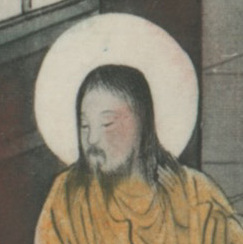
                Jesus and the rich man,
                Chinese depiction (1879)
              • One Bread, One Body:  "Losing everything to be saved":  We should be willing to sell or lose all we have if it's what the Lord wants from us.  We have only one goal in life: to be saved.  May we accept salvation whatever it takes:  sacrificing, trusting, suffering, simplifying, being counter-cultural—and experiencing the joy and freedom that ensue.
              • Passionist:  Today's readings challenge and encourage us to live as disciples:  Jesus invites the man who wants to know how to inherit eternal life to give what he has to the poor, then follow him; the man went away sad, for he had many possessions.  Then Jesus shocks his disciples by telling them how hard it is for the rich to enter the kingdom.  Many believed that rich = favored by God, on the way to the kingdom; some still do.  But wealth or power can be an obstacle.
              In the 1st reading, the author reminds his fellow disciples of the promise they have in Christ, even in trials.  Love is the key; how else could we give up everything to follow Jesus?  God’s love for us in Christ can get us through testing, suffering, times we don't feel God's presence, so we may rejoice.  It's beyond us but not beyond God.  All things have become possible for us, but not by us.
              • DailyScripture.net:  "Give, and you'll have treasure in heaven":  The rich man who wanted what money couldn't buy got a surprise answer.  Did he go away sad because he was possessive and his treasure and hope misplaced?  Treasure is connected to the heart, the place of desire, will, and focus.  The Lord is the greatest treasure we can have, so giving up anything else for him (attachment, friendship, job, lifestyle...) should give great joy and freedom.  Only God can satisfy our deepest longings.  Better the poor walking in integrity than the rich perverse in their ways. The camel was regarded as the largest animal; the needle's eye could be literal or describe the narrow gate of the city walls; you had to "lower" yourself to enter.  Wealth can make us falsely independent and lead us into selfishness.  The rich man and his sons who refused to help poor Lazarus neglected to serve God.  We lose what we keep and we gain what we give away. Generosity will be amply repaid, both in this life and in eternity....