February 23, 2017

Polycarp

February 23, 2017:  St. Polycarp, Bishop and Martyr

  • 'Money' tie:  Don't rely on deceitful wealth (1st reading)
  • 'Tree' pin:  One who delights in and meditates on the Lord's law is like a tree that yields fruit... (psalm)
  • 'Stone' tie pin:  Better that a millstone be put around your neck than your causing a little one to sin (gospel)
  • 'Hand' tie pin:  If your hand causes you to sin, cut it off.... (gospel)
  • 'Feet' pin:  If your foot causes you to sin, cut if off.... (gospel)
  • 'Eyeball' pin:  If your eye causes you to sin, pluck it out....  (gospel)
  • 'Fire' pin:  It's better to enter God's Kingdom without an eye than be thrown into the unquenchable fire; everyone will be salted with fire (gospel)
  • 'Peace sign' tie bar:  Keep salt in yourselves and you'll have peace with one another (gospel)
  • 'Youth Day' t-shirt [from 1998]:  "What are you waiting for?" theme (1st reading, gospel)
  • Red shirt, 'blood drop' pin:  Polycarp's martyrdom
Listen

  • Light of the world, from Godspell/ Schwartz ("If that salt has lost its flavor, it ain't got much in its favor"); more, with another version (gospel)
For Psalm 1
Pope Francis
Homily:  Don’t scandalize the little ones; scandal destroys!  Scandal is saying one thing and doing another; it is a double life, saying you're Catholic but not leading a Christian life:  not paying just wages, exploiting people, laundering money…  Christians like this scandalize others.  We've heard, "I'd rather be an atheist than a Catholic like that."  It happens every day, enough for it to be in the news:  At a company on the brink of failure, people hadn't been paid and couldn't afford their daily needs, but the head of the company, a Catholic, was on vacation on the beach....
Jesus talks about those who commit scandal.  He doesn't use the word, but we understand.  You'll knock at heaven's gate:  "Remember me?  I went to church, did this, made contributions..."  "Yes, I remember your dirty offerings, stolen from the poor.  I don’t know you."  The double life comes from following the heart's passions, the sins that are wounds of original sin.  The 1st reading tells us they don't satisfy.  Ask, is there something of a double life within me, of appearing just, of seeming a good believer but doing something else?  If so, is there excessive confidence?  "The Lord will forgive everything; I’ll keep going on like this."  Do you say, “This isn't going well.  I'll convert, but not today."  Scandal destroys!
To 'football' club:  Sports mirrors life and society:  you need each other.  Each player puts his skill and talent towards a common goal, to play well and to win.  You need much training to achieve that; invest time and effort in creating team spirit.  Act in the spirit of fellowship, leaving aside individualism; when you play for the group's good, it's easier to win.
Many watch and admire players.  Be a good model, highlighting companionship, effort, team play, and the beauty of the game.  Be grateful for the people who have helped you, including your first teammates, coaches, assistants, and fans.  These memories help you to be aware you're only part of a great team.  Our ‘game’ is not ours alone.  Keep playing and giving the best of yourself....
Read
  • Sir 5:1-8  Don't rely on your wealth, power, or strength; God will exact punishment.  Don't keep sinning, overconfident of forgiveness.  Don't delay your conversion!  Deceitful wealth won't help you on the day of wrath.
  • Ps 1:1-4, 6  "Blessed are they who hope in the Lord."  They're like a tree that yields fruit, while the wicked are  like chaff the wind drives away.  The Lord watches over the just.
  • Mk 9:41-50  "Whoever gives you a cup of water because you belong to Christ will be rewarded.  Whoever causes a little one to sin, it would be better if he were thrown into the sea with a millstone around his neck.  If your hand, foot, or eye causes you to sin, cut it off or tear it out; better to enter life maimed, crippled, or one-eyed than go into the unquenchable fire....  Keep salt in yourselves and you'll have peace with one another."
Reflect
    • Creighton:  Some identify Polycarp as a direct student of John the Apostle.  He served as Bishop of Smyrna and defended early Christianity against heresy.  His martyrdom is well documented.  He was burned at the stake when he refused to declare Caesar as Lord:  “Christ never did me wrong during the 86 years I've served him.  How can I blaspheme my King who saved me?”  Do we live our faith against daily challenges and temptations?  The 1st reading reminds us that God—not money, strength, ego, or arrogance—saves us.  We're not to delay our conversion or take for granted that we can do anything and be forgiven; we must not betray our relationship with Christ.  Jesus tells us to not judge others but to look at ourselves and recognize what causes us to sin.  He reminds his disciples their salt can become ineffective; they need to preserve what's right and get right before judging others.  May we tend to our “house” before criticizing others  [Reminds me of a joke]
      St. Polycarp
    • One Bread, One Body:  "Pass the salt?"  Jesus says we'll be "salted with fire."  Salt sealed covenants; we need to be sprinkled with the salt of the fire of repentance to be faithful to our baptismal covenant.  Incense was "to be salted and so kept pure and sacred."  Incense represents our prayers. Our prayer life must be salted with God's consuming fire of love. "Every offering you present to the Lord shall be seasoned with salt." We offer God our bodies as living sacrifices.  Sacrifices like fasting and self-denial are like sprinklings of fire that purify us; this kind of salt preserves from death.  Salt preserves and flavors.  A sprinkling of fire, which should destroy us, can preserve what's worthy in us....
    • Passionist:  “Delay not your conversion to the Lord.”  Perhaps the most fundamental requisite to conversion is surrender.  The closer we get to God, the more we realize we need to surrender to his will, and the more we rely on him; it's the only way to peace.  Jesus' words about cutting off our hand or foot stress the urgency of conversion; he challenges us to let go of whatever gets in the way of following him.  The world needs the Good News we've been given; the world needs acts of love, peace, and justice.  If we keep the seasoning of God’s love, we can be at peace, work peacefully with others, and spread peace to all.
    • DailyScripture.net:  "If your hand or eye causes you to sin":  We've been given the great reward of God, perfect love, source of life and happiness. God's love, poured into us, purifies us and compels us to show kindness and charity to our neighbor, who's created in God's image. We were created in love for love. The charity we show others in need expresses our gratitude for God's goodness to us. Jesus never refused to give to anyone in need who asked for help, and we're called to be as generous as he.  "God never asks his servants to do the impossible.  God's love and goodness is revealed as richly available, poured out on all.  God furnishes to each person the ability to do something good.  No one seeking to be saved will lack this ability, given by the one who said: 'whoever gives you a cup of water... will [be rewarded]'" (Gregory of Nyssa, On the Christian Mode of Life 8.1).
    Judas and the salt cellar,
    from Raffaelli's copy
    of Da Vinci’s The Last Supper
    Just as a doctor might remove a limb to preserve a life, so we must part with whatever can lead us to spiritual death. Jesus' disciples must never set a stumbling block by giving offense or bad example. The original meaning of 'scandal' is trap or stumbling block that causes one to fall; the Greek for 'temptation' is scandalon.  Teaching someone to sin was considered unforgivable; it could start a train of sin.  The young in faith are especially vulnerable to bad example.
    Salt gave food flavor and preserved meat from spoiling; it was a symbol of fellowship and sharing a meal with friends. "Betraying the salt" meant betraying one's master or friends; Da Vinci in his Last Supper depicts Judas tipping over the salt, symbolically identifying him as the betrayer.
    As salt purifies, preserves, and flavors food, so disciples of Christ must be salt to purify, preserve, and flavor the world with justice, peace, joy, and mercy.  Salt used to be put in ovens to intensify the heat, then was thrown onto the footpath when burned off and no longer useful.  Perhaps Jesus contrasted useful salt and spent salt to encourage us to bring the flavor of Christ's love, holiness, and justice to the world.
    We're called to be "the aroma of Christ to God among those being saved and those perishing, to one a fragrance from death to death, to the other a fragrance from life to life," The Lord wants his fragrance to permeate our thoughts, speech, and actions....

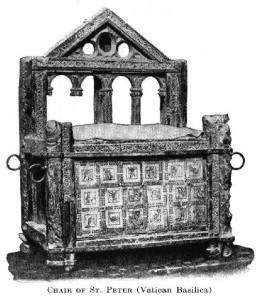
    Peter's chair

    February 22, 2017:  Chair of St. Peter, Apostle

    See 12 connections with today?
    Legend below

    Listen
    Creation is a marvelous gift from God to us, so we can enter into relationship with him, recognize his love, and collaborate with him every day.  But when we sin, we break our communion with God and mar the original beauty of human nature and creation.  We damage our communion with what surrounds us and corrupt creation.  We see the consequences every day:  humanity loses its beauty and disfigures all around it; what pointed to the Creator and his love then carries the sign of pride and human voracity.
    But the Lord doesn't abandon us; he offers us a new horizon of freedom and salvation.  Paul reminds us of this by inviting us to hear creation's groaning.  “If we listen, everything around us groans:  Creation groans; we groan; the Spirit groans in our hearts.  These groans speak of birth pangs; they're the groans of one who suffers but knows new life is coming.  Despite our failings, we know we're saved by the Lord, and we contemplate and experience signs of the Resurrection, of a new creation.  Christians live in the world, not outside; we read all things informed by Easter, with the eyes of the Risen Christ.  When we're discouraged or losing hope, the Spirit helps us keep our groans and hopes alive.  The Spirit sees beyond negative appearances and reveals to us the new heavens and earth the Lord is preparing.
    Read
    • 1 Pt 5:1-4  Presbyters, tend God's flock in your midst, overseeing willingly and eagerly.  Be examples.  When the chief Shepherd is revealed, you'll receive the crown of glory.
    • Ps 23:1-3a, 4-6  "The Lord is my shepherd; there is nothing I shall want."  I fear no evil; you give me courage.  Goodness and kindness follow me; I shall dwell in the Lord's house.
    • Mt 16:13-19  Jesus / disciples:  “Who do they say the Son of Man is?” / “John the Baptist, Elijah,... a prophet.” / “Who do you say I am?”  Peter:  “The Christ.” / “My Father revealed this.  You are Peter; upon this rock I'll build my Church.  I'll give you the keys to the Kingdom.  What you bind/loose on earth shall be bound/loosed in heaven.”
    Reflect
      • Creighton:  ‘Chair’ is a title of the person in charge.  Today's feast celebrates the spiritual authority of the one called to exercise Peter's role in the church, from Peter to Pope Francis and beyond.  Jesus was concerned about how authority was to be exercised:   “Whoever wishes to be great among you will serve you; whoever wishes to be first will be the slave of all.  The Son of Man came not to be served but to serve and give his life....”
      Today's gospel illuminates the authority that Jesus gave to Simon, referring to the “binding and loosing” a chief rabbi exercised.  ‘Binding’ meant interpreting how the Law was to be applied in a certain case; ‘loosing’ meant lifting excommunication.  Peter was given great authority. To make sure it's used in the way of Jesus, John refers to the authority using the metaphor of sheep herding.  Recent popes have taken to heart the teaching of authority through love and service.  May we who exercise some authority in our communities do so in the same spirit, guiding, nurturing, serving...
        A real chair...
      • One Bread, One Body:  "Finding elusive Church unity":  We've paid a high price for disunity in the Church.  In one Spirit, we've been baptized into the one body of Christ, the Church. The Spirit makes the Church one.  The authority of the pope and bishops helps us grow in unity....
      • Passionist:  What someone says or does reflects the movements of their mind and heart.  Peter proclaims from the heart, “You are the Christ....”  From that point, he couldn't turn back; he knew Jesus was the Messiah and spent the rest of his days discovering how that would affect his daily living.  He learned to live in a way that matched his faith in Jesus as Son of the living God.  Our Feast and 1st reading tell us what Peter did for us and the Church.  Peter was a witness to Jesus' suffering, death, and Resurrection; he allowed Jesus to conform his mind and heart to the Messiah's.  Peter encouraged his presbyters and successors to watch over God’s People with love and tenderness.  Peter passed on a way to live our faith:  hold Jesus' suffering, death, and resurrection in our hearts as Peter did.  Deal with one another in line with our faith.  Peter understood the keys of the Kingdom were given to open life in the Lord up to everyone.  The greatest witness to faith is a life lived according to Jesus' mind and heart of Jesus....
      • DailyScripture.net:  "The keys of the kingdom of heaven":  Jesus was widely recognized as a mighty man of God, even like a great prophets, but Peter exclaimed he was the Messiah; only God could have revealed that to him.  "Peter said 'you are the Christ, the son of God.'  There are many christs [anointed ones] by grace, adopted [as children], but only one Son of God by nature.  In calling him Son of the living God, Peter indicates that Christ is life, and death has no authority over him.  Though he was weak in the flesh and died, he rose; the Word couldn't be held under the bonds of death" (Cyril of Alexandria, Fragment 190, paraphrased).
      Jesus plays on Peter's name, Greek and Aramaic for 'rock.'  It was a compliment to call someone a 'rock.'  When God saw Abraham, he exclaimed: "I've discovered a rock to found the world on."  Through faith Peter grasped who Jesus was.  The New Testament describes the church as a spiritual house with members joined together as living stones.  Faith in Christ makes us into rocks, spiritual stones.  Jesus confers on Peter authority to govern the church Jesus would build.  "Christ is a rock never disturbed or worn.  Peter gladly received his name from Christ to signify the faith of the church.… The devil is the gateway of death who always stirs up against the church calamities, temptations, and persecutions, but Peter's faith, founded on the rock of Christ, abides unshaken. The keys of the kingdom have been handed down so that one bound on earth has been bound in heaven, and one set free on earth has been set free in heaven (Epiphanius, Interpretation of the Gospels 28, paraphrased).  The Lord offers us faith, hope, and love, and boldness to proclaim him as Savior bringing God's kingdom now and forever....
      • About "binding and loosing" (gospel, original in future perfect despite English translations), linked to Sacrament of Reconciliation, see my original post with exegetical links, related speculations, plus links to online resources for comparing and exploring original and translated Bible texts.
      • Universalis:  Today's feast, celebrated since at least the fourth century, signifies the unity of the Church founded upon the Apostles.
      Dress legend
      • 'Sheep' tie bar:  The Lord is my shepherd (psalm); Tend God's flock... (1st reading)
      • 'Crown' tie bar:  ...and you'll receive the unfading crown of glory (1st reading)
      • '?' tie pin:  Who do people say the Son of Man is?  Who do you say I am?  (gospel)
      • 'Blood drop' pin:  "Flesh and blood didn't reveal this to you..." (gospel); Peter's martyrdom
      • 'Rock' tie pin:  Upon this rock I'll build my church (gospel)
      • 'Keys' (tie and tie pin):  I'll give you the keys to the Kingdom (gospel)
      • 'Knot with two jewels' tie bar:  jewels for earth and heaven, knot for bind/loose "syncing" (gospel)
      • White, green, and blue shirt, green suspenders:  white for the feast, green for "verdant pastures" and Ordinary Time season, blue for "restful waters" (psalm)
      • 'Messiah' t-shirt (not seen):  "You are the Christ" (gospel)

      February 22, 2017

      Feb. 21

      February 21, 2017:  Tuesday, 7th week, Ordinary Time

      • 'Hearts' suspenders:  Be sincere of heart; love the Lord and your hearts will be enlightened (1st reading); take delight in the Lord, and he'll grant you your heart's requests (psalm)

      • 'Clock' pin:  Wait on God, with patience;... (1st reading)

      • 'Owl' tie pin:  ...thus you'll be wise (1st reading)

      • 'Fire' pin; gold- and silver-colored accessories:  In fire gold and silver are tested... (1st reading)

      • '?' tie pin:  Jesus' disciples were afraid to question him; Jesus asked what they were arguing about (gospel)
      • 'Children' tie:  "Whoever receives a child in my name, receives me" (gospel)
      • Green shirt:  Ordinary Time season
      Listen

      1st reading-inspired
      Pope Francis

      Homily:  We're all tempted.  The disciples don't understand why Jesus told them of his coming death but are too afraid to ask what he means.  This is the temptation to not complete the mission; even Jesus suffered it.  The gospel also mentions the temptation of ambition; the disciples argue about who's the greatest and are ashamed to tell Jesus.  They don't realize the path of service isn't easy.  We do it too; ask the Lord for the grace to be ashamed when we do.
      Jesus overturns this logic when he reminds them that to be first, you need to be last and the servant of all and that receives a child in his name is receiving him and the One who sent him.  Pray for the Church, for us all, that the Lord may defend us from ambition.  Lord, give us the grace of holy shame when we're in that situation, when I see you on the cross but want to use you to climb the ladder.  Give us the grace of childlike simplicity.  Say, "I am an unworthy servant.’”
      At migration and peace forum:  Migration involves nearly every part of the world.  Unfortunately, the movement is usually forced, caused by conflict, disasters, persecution, climate change, violence, poverty, or inhumane conditions.  A coordinated, effective response is urgent.  We must welcome, protect, promote, and integrate:
      Welcome:  Rejection makes us see our neighbor as unworthy of our attention, a rival, or someone to be bent to our will; it's rooted in self-centeredness and amplified by populist rhetoric.  We need a generous welcoming attitude to overcome indifference and counter fears.  We must open channels for those fleeing conflict, persecution, or the grip of organized crime.  Welcome begins with offering decent and appropriate shelter....
      Protect:  Migration can make people more vulnerable to exploitation, abuse, and violence.  We must defend the rights of migrants, exiles, asylum seekers, and trafficking victims, ensure their freedom, and respect their dignity; it's a moral imperative requiring us to adopt clear and relevant juridical instruments, implement just political choices, prioritize processes, implement timely and humane programs to fight human trafficking, and coordinate efforts.
      Promote:  We must promote an integral human development of migrants, exiles, and refugees by attending to justice, peace, and care of creation.  Development is a right of every human being and so must be guaranteed by ensuring the conditions for its exercise, including access to fundamental goods and the possibility of choice and growth.  Coordination is needed here too.  Promotion of migrants and their families begins with their communities of origin.  They should have the right to emigrate and the right not be constrained to emigrate (e.g., the right to live a dignified life in their homeland).  We must encourage programs of international cooperation and transnational development where migrants are active protagonists.
      Integrate:  Integration (not assimilation nor incorporation) is rooted in recognition of each other’s cultural richness; it's not superimposing your culture over another's, or mutual isolation.  Those who arrive shouldn't close themselves off from the receiving country's culture and traditions; they should respect its laws.  Policies must favor the reunion of families.  We must help indigenous populations be aware of and open to integration; this requires programs that foster encounter with others.  For the Christian community, peaceful integration of persons of various cultures reflects its catholicity, since unity is part of the life of the Church, who open to all and desires to embrace all.
      We must do these individually and together; it's a duty of justice, civility and solidarity:
      Justice:  Don't sustain unacceptable economic inequality.  We're called to respectful, responsible apportionment inspired by distributive justice.  Find ways all may benefit from the fruits of the earth; it's a question of justice, equality, and respect.  Don't We can't allow for entire peoples to have a right only to the crumbs.  We have a responsibility to care for the planet and should interpret it with the principle of subsidiarity.  Reconcile history with our present situation, not exploiting people or places or using the market to increase the well-being of the few....
      Civility:  Every migrant is a human person with inalienable rights everyone must always respect.  We must affirm the centrality of the human person and never let circumstances or bureaucracy obscure human dignity.  Irregular legal status can't allow migrants to lose their dignity.  From the duty of civility comes the value of fraternity, founded on the relational constitution of the human person.  Without fraternity we can't build a just society or lasting peace.  Fraternity is the most civil way of relating with another person.  
      Solidarity:  Since we were created, God has asked, “Where is your brother?”  The question is directed to each of us.  Solidarity is born from the capacity to understand the needs of people in difficulty and to take responsibility for those needs.  The hospitality we offer to strangers, and so to Christ himself, is based on this.  The duty of solidarity is to counter throwaway culture and give attention to the weakest, poorest, and most vulnerable.  So everyone's attitude toward migrants and refugees needs to change, from defensiveness, fear, indifference, and marginalization, based on throwaway culture, to attitudes based on a culture of encounter.
      We're especially called to welcome, protect, promote, and integrate children and young people forced to live far from home, away from their loved ones. 
      Read
      • Sir 2:1-11  When you come to serve the Lord, stand in justice and fear, prepare for trials.  Be sincere, steadfast, patient; listen.  Cling to God and so be wise.  Accept what befalls you.  Trust God and God will help you; hope for good things, joy and mercy.  Love the Lord; you'll be enlightened.  The Lord is compassionate and merciful; he forgives and saves, protecting all who seek him.
      • Ps 37:3-4, 18-19, 27-28, 39-40  "Commit your life to the Lord, and he will help you."  Trust in the Lord and do good.  Salvation is from the Lord; he delivers the just who take refuge in him.
      • Mk 9:30-37  They didn't understand “The Son of Man is to be handed over, be killed, and rise.”  As they discussed who was the greatest, Jesus told the Twelve, “To be first, be the last and servant of all....  Whoever receives a child in my name, receives me and the One who sent me.”
      Reflect
        • Creighton:  Jesus challenges the apostles to desire to rank first, first in service.  Be childlike and welcome the childlike.  A child is powerless, yet trusting, and we are asked to welcome the powerless, those whose hearts are open to hope....
        • One Bread, One Body:  "Hope in God":  Joseph, though sold into slavery and imprisoned, best years of his life, never wavered in hope, and God restored him beyond what he could have imagined.  Abraham, Joshua, Caleb, and Ruth also suffered, but they hoped in the Lord and weren't disappointed.  Trials, adversity, and testing can strengthen and purify us, though we can be tempted to lose hope.  As we lose hope, we become more susceptible to sin, and sin can drain our hope.  Lord, increase our hope.
          Jesus and the little child/ Tissot
        • Passionist:  Sirach steers us away from ourselves.  He shows us as being acted upon by circumstances out of our control, as victims of misfortune, being tested.  He tells us to forget ourselves and reach out to the Lord.  This change in focus can position us to experience the Lord and his help.  Our compassionate and merciful God becomes the center.  In today's gospel Jesus exhibits passivity before the circumstances engulfing Him, which will lead to his death.  He expands on the implications of this:  accept being last, put aside personal ambition, and be childlike.  We can want to be the center of attention, overlooking what's around us.  Our situation can change, negating our self-absorption, challenging us, reducing our agency.   See other things in life’s mirror:  I see His blood upon the rose (Plunkett).
        • DailyScripture.net:  "Who's the greatest in God's kingdom?"  There's no share in God's glory without the cross.  Jesus' disciples didn't understand his prophecy of his betrayal and crucifixion because it's not how they understood the Messiah, but they were afraid to ask questions.  We too can reject what we don't want to see?  Do we mold our lives according to God's word?  We can also compare ourselves to others and want greatness and praise.  Jesus embraced a child to show who's really the greatest. Children had no rights, position, or privileges.  Jesus placed the child in a position of honor.  The greatest in God's kingdom are the humble, who empty themselves of pride and self-seeking glory by taking the position of a servant or child.  Jesus is our model:  he came to serve, not be served; he emptied himself, taking the form of a servant, taking on our nature that he might raise us up.  God gives grace to the humble.  To receive God's life and power, we need to empty ourselves of all that stands in the way; God wants empty vessels to fill with his glory, power, and love.

        • Today's saints, from Universalis

        February 20, 2017

        Feb. 20

        February 20, 2017:  Monday, 7th week, Ordinary Time

        • 'Owl' pin:  Wisdom comes from the Lord (1st reading)
        • 'Abacus' tie pin:  Who can number the sand, raindrops, or days of eternity? (1st reading)
        • 'Ruler' tie bar:  Who can explore heaven's height, earth's breadth, or the abyss's depth? (1st reading)
        • 'Dove' pin:  The Lord created wisdom through the Spirit (1st reading)
        • 'Crown' tie bar:  The Lord is king (psalm)
        • 'Alps' tie pin:  Jesus came down from the mountain (gospel)
        • 'Car' pin:  Jesus' disciples couldn't 'drive' out the evil spirit (gospel)
        • 'Fire' pin:  The evil spirit often threw the boy into the fire (gospel)
        • 'Hand' tie pin:  Jesus took the boy by the hand (gospel)
        • Green shirt:  Ordinary Time season
        Listen


        Never go down the road of revenge or resentment.  Instead, pray for those who want to do evil; it's the Christian path to holiness and brings peace.  Jesus explained the tools needed to travel this road.  "Don't resist evil"; that means no revenge.  A heart full of resentment takes away my holiness.  “You'll pay for what you did to me” isn't the language of a  Christian.  No; God tells us to pray for those who slander us.
        The wars we see in the news is the same hatred you have in your heart for that relative.  To forgive from the heart is the road of sanctity.  If God is merciful, holy, and perfect, so must we be.  One who is deserves to be canonized.  The Christian life is simple.  Prayer is an antidote against hatred, against war.  If someone doesn’t  like you, pray for them; powerful prayer overcomes evil and brings peace.
        Read

        • Sir 1:1-10  Wisdom comes from the Lord.  Who can number raindrops or the days of eternity or explore heaven's height or earth's breadth?  Wisdom was created before anything else.  The Lord created her through the Holy Spirit and poured her forth upon every living thing.
        • Ps 93:1-2, 5  "The Lord is king; he is robed in majesty."   You made the world.  Your decrees are trustworthy.
        • Mk 9:14-29  “Teacher, here's my son, foaming at the mouth, possessed by a spirit your disciples couldn't drive out.” / “Everything is possible to one with faith.” / “I believe; help my unbelief!” He drove the spirit out and raised the boy. To disciples: “This kind can only come out through prayer.”
        Reflect
          • Creighton:  Today's 1st reading reminds us of God’s infinite love, power, and wisdom, limitless even regarding my life, our political arena, and how we hurt each other.  May I remain hopeful that God’s wisdom pour forth in today's hopeless situations, old grudges, and violent aggressions.  The reading reminds us of our smallness, God's greatness, and his wisdom poured upon all creation.  Do I trust God's power and wisdom in my daily life?  I sometimes act like my wisdom or experience supersedes God's; I think I can fix situations without relying on God.  The gospel miracle doesn't take place till the boy's father declares faith in Jesus.  What do I need to ask Jesus for help with?  What healings am I grateful for?
            The Exorcism
          • One Bread, One Body:  "Distress management":  Jesus expressed exasperation to the crowd for their lack of faith.  When we're around people who lack faith, are we distressed and do we speak as Jesus did?  Jesus challenged the father's faith, raised its level, then taught his disciples to expel demons by prayer....
          • Passionist:  The father is desperate to help his boy.  He argues with the disciples because he brought his son to be cured but they couldn't cast the spirit out.  Was he telling them to try harder, or calling them phonies.  Hear his discouragement when he cries out, “I believe; help my unbelief!”  He wants to believe but is struggling with his dashed hopes.  Later, Jesus tells the disciples the spirit can only come out through prayer (his or the boy's father's?)  It’s easy to get discouraged, even overwhelmed, by failures or dashed hopes, but Jesus shows such compassion to this father, who felt he lacked the faith.  Jesus, help me believe and trust you'll give me what I need in spite of my lack of faith.
          • DailyScripture.net:  "All things are possible to a believer":  In today's gospel Jesus' disciples brought disappointment to a pleading father because they couldn't heal his son.  Jesus' apparently stern response was actually compassionate.  He was dismayed with their lack of faith and concerned to meet the boy and his father's needs.  Jesus challenged the father to believe.  Prayer and faith go together: "Where faith fails, prayer perishes.  Who prays for something he doesn't believe in?  Believe so you may pray, and pray that the faith by which we pray not falter" (Augustine).  The Lord gives us his Spirit that we may be able to ask our Father for help.
          When Jesus rebuked the evil spirit, the boy first seemed to get worse.  "Though it was the boy who fell, it was the devil in him who was in anguish.  The boy was merely convulsed, while the awesome judge was convicting the spirit.  The captive was detained, but the captor was punished.  Through the wrenching of the body, the punishment of the devil was made manifest" (Peter Chrysologus).
          Jesus' works and signs demonstrate that the kingdom of God is present in him and the Father sent him; they invite belief in Jesus as Son of God and Savior.  His exorcisms anticipate his victory over "the ruler of this world."  Jesus can deliver us from any affliction....

          7th Sun., Ordinary Time

          February 19, 2017:  Seventh Sunday in Ordinary Time

          • 'Heart' pin, 'love' sticker on suspenders:  Don't bear hatred in your heart.  Love your neighbor as yourself (1st reading); love your enemies (gospel)
          • 'Crown' tie bar:  The Lord crowns you with kindness and compassion (psalm)
          • 'Dove' pin: The Spirit dwells in you (2nd reading)
          • 'Owl' tie pin, 'John's Jokers' tie:  The world's wisdom is foolishness to God (2nd reading)
          • 'Eyeball' tie pin:  No longer "an eye for an eye" (gospel)
          • 'Coin' tie bar:  Don't refuse one who wants to borrow (gospel)
          • 'Sun' tie pin:  The Father makes the sun rise on the bad and the good (gospel)
          • 'Walker' tie pin:  Go the extra mile (gospel)
          Listen

          For Psalm 103
          For future Sundays
          Pope Francis Angelus
          Today's gospel expresses the Christian “revolution” well.  Christ shows the path of true justice, through the law of love that overcomes that of retaliation.  Jesus doesn't just ask that we bear evils patiently, but to return good for evil; only then can the chains of evil be broken.  Refusal to return evil for evil can involve giving up a legitimate right:  turning the other cheek, giving up your cloak,...  But this doesn’t mean that the needs of justice should be ignored or contradicted; Christian love, manifested in mercy, represents a superior realization of justice.
          Jesus teaches the distinction between justice and vengeance.  It's our right to ask for justice and our duty to practice it, but we can't exact or encourage revenge, hatred, or violence.  Christ’s law of love calls us even to love our enemies.  This isn't approval of their actions, but an invitation to a higher perspective, like the Father's.  They're created in God's image, even if their acts obscure the image.  Christ calls us to respond to them with goodness, inspired by love.
          May Mary help us follow this demanding path that exalts human dignity and makes us live as children of our heavenly Father.  May she help us practice patience, dialogue, forgiveness, and to be artisans of communion....
          Read
          • Lv 19:1-2, 17-18  Be holy, for I, the Lord, am holy.  Don't bear hatred in your heart.  Cherish no grudge.  Love your neighbor as yourself.
          • Ps 103:1-4, 8, 10, 12-13  "The Lord is kind and merciful."  Bless the Lord who pardons, redeems, heals, shows compassion and mercy.
          • 1 Cor 3:16-23  You're God's holy temple; the Spirit dwells in you.  If you consider yourself wise, become a fool; the world's wisdom is foolishness to God.  Don't boast about people; we belong to you, you to Christ, and Christ to God.
          • Mt 5:38-48  You've  heard, Eye for eye and tooth for tooth, but I tell you, Offer the wicked no resistance.  Turn the other cheek.  Hand over your cloak. Go an extra mile.  Give and lend.  You've heard, Love your neighbor, but I tell you, Love your enemies and pray for your persecutors, that you may be your Father's children.  Be perfect like your Father.
          Reflect
            • Creighton:  We get daily opportunities to judge poorly, act selfishly, explode in anger, or make shortsighted decisions, forgetting who we are, who God is, and how God acts.   Today’s readings ask us to remember who we are, to whom we belong, and how to act. 1st reading:  Others may need correction, but don’t incur sin because of them.  Psalm: The Lord is kind, merciful, slow to anger.  2nd reading:  You're God's temple; worldly wisdom is foolish.  Gospel:  love your enemies; be perfect.  Don't retaliate.  We depend on Grace to be whole, holy, blameless (senses of 'perfect') scripture scholars give us these words as a better translation of “perfect”).  To whom have I been kind and merciful today?
            • One Bread, One Body:  "Loving those who hurt you":  Jesus surprised his fellow Jews by saying that loving others is the second commandment, and with the first the basis of the law and prophets.  The second commandment is more than being friendly and helping out; it's not bearing hatred, taking revenge, or holding a grudge, so Jesus was prohibiting those.  Do I love your neighbor according to God's standards?
            • Passionist:  Before Jesus' time Jews and others taught that our holiness is connected with our love of God and neighbor.  God created us so we could love God and others. This teaching was written down and handed on because we need to be reminded.  We may not realize we carry hate till we're wronged, done injustice, or slighted.  We may manifest it slowly or let it gush out; either way, it's destructive.  Once we believe we can hate, reject, dehumanize, or ignore the other, we turn our backs on others.  It takes faith for us to love God and neighbor, overcoming our tendency to hate, remembering hatred has disguises, masks, and ways of being expressed.  The wise of this world think they can lie without consequence, and that most people are like them, so they can make destructive, dehumanizing laws.  We're called to love unconditionally, wholeheartedly....
            • DailyScripture.net:  "Don't return evil for evil":  Jesus approached the question of retribution by giving a standard based not on giving people their due but on grace, love, and freedom.  "Eye for eye," cruel as it sounds now, was meant to limit vengeance as a step towards mercy; it was generally not taken literally but guided judges in assessing penalty.  The Old Testament commands mercy:  Don't take vengeance or bear grudges but love your neighbor.  Feed the hungry and give drink to the thirsty, even enemies.  Don't pay people back for what they did.  Give your cheek to the smiter, and be filled with insults.  Jesus transforms the law of mercy with grace, forbearance, and loving-kindness, with no room for retaliation.  We must seek the good of those who wish us ill.  Do I?
            Only the cross can free us from malice, hatred, revenge, and resentment and give us courage to return evil with good.  Jesus suffered insult, abuse, injustice, and death for our sake.  As God has been merciful towards us through the offering of his Son, we're called to be merciful towards our neighbor, even those who harm us.  God gives power and grace to believers; his love conquers all, even our hurt, fear, and prejudice.
            Jesus' command to "be perfect" parallels two passages from the Hebrew scriptures:  God instructed Abraham to "be perfect/blameless" before God.  The original meaning of 'perfect' (Hebrew and Aramaic) is 'completeness,' 'wholeness,' 'not lacking in what's essential.'  And God commanded Moses and Israelites to "be holy, for I am holy." God created each of us in his image and calls us to grow to become like him, loving as he loves, choosing to do good and reject evil.  God, who knows our sinfulness and weaknesses, assures us of his love, mercy, and help, and so gives us his power, strength, and gifts so we may have all we need to do his will and live as his children....