March 26, 2017

Laetare

March 26, 2017:  Fourth Sunday of Lent / Laetare Sunday

Today's guest dressers Jamie, Sid, and my mom
Listen

Mainly gospel-inspired

For 2nd reading

For Psalm 23
For future celebrations
See 16 connections with today?
Legend below
Pope Francis Angelus
In his healing of the man born blind,  Jesus reveals himself as light of the world.  Each of us is blind from birth, in that we were created to know God, but because of sin we need a new light, of faith, that Jesus has given us.  The man born blind is opened up to the mystery of Christ.  He represents us when we don't realize Jesus is the light of the world and look elsewhere and rely on small lights when fumbling in the dark.
Christ has enlightened us in baptism and called us to behave as children of light.  What does it mean to have true light and walk in the light?  First, to abandon false lights such as self-interest.  If we evaluate people and things based on the criterion of our profit, pleasure, or prestige, we're not being truthful.
The Holy Spirit leads us to the mystery of the death of Christ:
Papal Preacher Fr. Cantalamessa's 3rd Lenten Homily
(summary concluded from yesterday)
Death was swallowed up in victory:  There's only one true remedy to death, and we're robbing the world if we don't proclaim it by our words and lives.  "If many died through one man’s trespass, more have God's grace and the grace of Jesus Christ abounded for many....  If because of one man’s trespass, death reigned through that one man, more will those who receive the grace and gift of righteousness reign through Jesus Christ."  "Death is swallowed up in victory.  Death, where's your victory?  Where's your sting?  The sting of death is sin, and the power of sin is the law.  But thanks be to God, who gives us the victory through our Lord Jesus Christ."  The decisive factor occurs when Christ dies.  But what changed the nature of death?  The Son of God descended into the tomb but came out on the opposite side.  He didn't turn back like Lazarus, who had to die again, did, but opened a breach on the other side through which all believers can follow him.  “He took on himself the suffering of man, suffering in a body which could suffer, but through the Spirit that can't die slew death.”  “By his passion our Lord passed from death to life and opened a way for us...  that we too may pass from death to life” (Augustine).  Death becomes a passageway to what doesn't pass away!  "We do die, but we don't continue in it, which is not to die at all.  For the tyranny of death is when he who dies is never allowed to return to life.  But when after dying is living, and a better life, this is sleep, not death" (John Chrysostom).
All these ways of explaining the meaning of Christ's death are true but not the most profound, which is found in what Christ, through his death, brought to the human condition, more than what he came to remove from it:  God's love, not human sin.  Jesus didn't die a violent death merely to pay a debt human beings owed; he died so that human suffering and death would be inhabited by love!  We were condemned to die alone, but entering death we discover God's love now permeates it.  Love couldn't dispense with death because of human freedom:  God's love can't eliminate evil and death with a magic wand; his love must allow suffering and death.  But since love penetrated and filled death, love now has the last word.
What changed about death because of Jesus?  Nothing and everything!  Nothing in terms of reason, everything in terms of faith.  We still have to enter the tomb, but now there's the possibility of exiting.  This explains the believer’s paradoxical attitude in the face of death, similar to other people's yet so different.  Sadness, fear, and horror, since they know they must go into the abyss, but hope since they know they can leave it.  “Those saddened by the certainty of dying [are] consoled by the promise of immortality.”  "We wouldn't have you ignorant concerning those who are asleep, that you may not grieve as those with no hope.  Since we believe Jesus died and rose, through Jesus God will bring with him those who have fallen asleep."  Paul does not ask them not to grieve but tells them “not to grieve as [unbelievers] do.”  For believers death is not the end of life but the beginning; it's not a leap into the void but into eternity.  It's a birth because only then does real, everlasting life begin.  The connection between the earthly life of faith and eternal life is like that between an embryo's life in a mother’s womb and the born baby's.  "It is this world which is in travail with that new inner man that is 'created after God's likeness.' When he has been shaped and formed here, he is born perfect into that perfect world which never grows old.  As nature prepares the fetus for life is in the light, so it happens to the saints" (Cabasilas).
Death is also a baptism; it's how Jesus describes his own death:  “I have a baptism to be baptized with.”  Paul speaks of baptism as being “buried with him by baptism into death.”  At the moment of baptism a person used to be completely immersed in water; all their sins and fallen nature were buried, and the person emerged a new creature, symbolized by the white robe.  The same thing happens in death:  caterpillar dies; butterfly is born.  God “will wipe away every tear, and death shall be no more, neither shall there be mourning nor crying nor pain, for the former things have passed away,” buried forever.
An important aspect of Catholic ascesis has been “preparation for death,” meditation on death and on a description of its stages and its progression from the periphery of the body to the heart.  Many depictions of saints show them with a skull nearby, even Francis who had called death “sister.”  Inscribed above a skeleton in the Capuchin Crypt is “What you are now we used to be; what we are now you will be.”  All this can be a useful reminder in our secularized and unthinking age.  It's wrong to say Christianity advances by the fear of death; Christianity actually removes the fear of death.  Christ came to “deliver all who through fear of death were subject to bondage”; Christianity advances because of the though of Christ's death, not ours!  So it's more effective to meditate not on our own death but on Jesus' passion and death, as has been the daily bread of generations before us.  The meditation generates emotion and gratitude, not anxiety; it makes us exclaim, Christ “loved me and gave himself for me!”
Pick up a Gospel and slowly read its entire passion account.  "We adore you, O Christ, and we bless you, because by your holy cross you have redeemed the world.”
Read
  • 1 Sm 16:1b, 6-7, 10-13a  Lord to Samuel:  “I'm sending you to Jesse; I've chosen my king from his sons.”  Samuel thought he was among the seven presented to him, but the Lord said no:  “Man sees appearance, but God looks in the heart.”  Jesse brought David; God told Samuel to anoint him.
    Wordle: Readings 3-30-14
  • Ps 23:1-6  "The Lord is my shepherd; there is nothing I shall want."  You lead and guide me and give me rest and courage.  You're at my side; I'm unafraid.  You spread the table before me and anoint me.  Goodness and kindness follow me, and I'll dwell with God.
  • Eph 5:8-14  You were once darkness but are now light in the Lord.  Live as children of light; learn what pleases God and expose works of darkness.  “Awake, sleeper; Christ will give you light.”
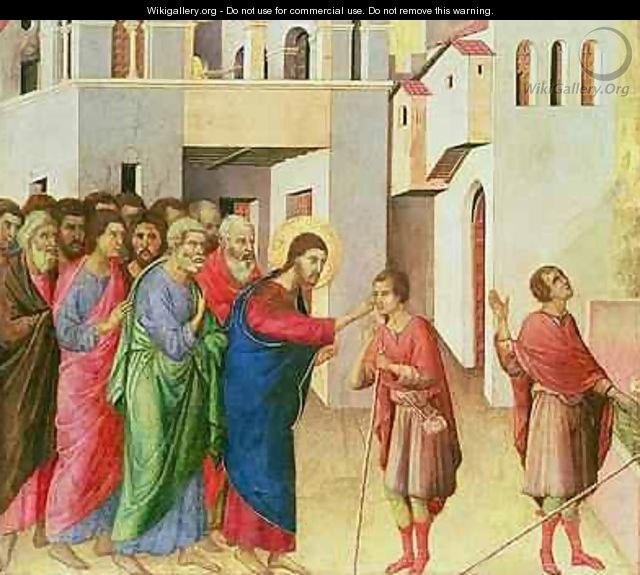
  • Jn 9:1-41  Jesus restored sight to man born blind who told those who first asked, then the Pharisees, who were divided about how Jesus who didn't keep sabbath could heal him.  The Jews summoned his parents who confirmed he was born blind, then called the man again, heard him speak of Jesus, and expelled him.  Jesus found the man:  "Do you believe in the Son of Man, the one speaking with you?" / “I do, Lord.”...  Pharisees / Jesus:  "You think we're blind?" / "You say, ‘We see,’ so your sin remains."
Reflect
    • Creighton:  Today's gospel illustrates how we can refuse to see.  Where are my blind spots?   When do I refuse to believe despite what I see?  How often have I spun actions to fit in with what I want to believe?  Refused to let facts challenge my beliefs or opinions?  Dismissed the possibility of looking from a different perspective?  Rationalized so I don’t have to look at an issue differently?  We put ourselves through convolutions so that facts don’t interfere with our beliefs.  We see what we want or expect.  We're reminded to see people as they are, not as they appear.Lord, help us to see with the eyes of Jesus so that we may find God in others.
      Jesus opens the eyes of a man born blind/ Duccio
    • One Bread, One Body:  "Sight for sore eyes":  There are human and divine ways of seeing. Because we've been baptized into Christ, we can share in God's way; God enlightens "the eyes of our hearts" when we live our Baptisms:  loving God and others ("Those who hate are in darkness; they walk in shadows, not knowing where they're going, since the dark has blinded their eyes."), rejecting worldly ways to avoid being blinded by the god of the present age, seeing Jesus as he is, and seeing God "face to face."  "I came into the world to make the sightless see and the seeing blind.'"  "Blest are your eyes because they see."
    • Passionist:  Today’s readings are about seeing and not seeing:  the blind see; those who should be able to see are blind to what's before them.  From the 1st reading:  “Not as man sees does God see, because man sees the appearance but the Lord the heart.”  Samuel, sent to anoint one of Jesse's sons as king, doesn't see whom he needs to see, then asks Jesse whether he has other sons.  David, the youngest, was the one called.  May we see with the eyes of Christ:  see him in in every person, not just externals; see him within us, not just our failings; see what we usually don't....
    • DailyScripture.net:  "Jesus frees us from spiritual blindness and sin":  God wants to recognize the light of his truth and wisdom.  God replaced Saul, who didn't recognize God's power to save him, with David, Jesse's youngest son, a man after God's own heart who did what pleased the Lord.  With strength from God, David defeated his enemies and united his people.
    Sin keeps us from God's truth, wisdom, and strength; it blinds us and keeps us from rising on our own to walk in God's love and truth.  Sin clouds the mind and makes it resist God's truth; only God's light can uncover it and free us to walk with God.  The Jews thought many infirmities were the result of sin.  Jesus' disciples asked him what sin caused the man's blindness; he answered that God allowed it to demonstrate his power.  He stated, "I am the light of the world," the source of power who sustains life and overcomes sin, confusion, and blindness.  His works confirmed his message and authority.
    Jesus awakened hope in the blind man, then identified with his misery and drew faith from him by touching his eyes with spittle and dirt and bidding him to wash in a pool likely used to purify people going to worship in the Temple.  His healing is more than a miracle; it's a sign pointing to Jesus, source of life-giving water.  The Pharisees were upset with the miracle because it violated the Sabbath and involved a "sinner"; their prejudice blinded them to God's intention for the Sabbath (to do good) and Jesus' claim to be from the Father to bring freedom and light.  They tried to intimidate the man and his parents by threatening to oust them from the worshiping community; they shunned him because he believed Jesus healed him and was the Messiah.
    "The Jews cast him out of the Temple; the Lord of the Temple found him" (John Chrysostom).  If our witness of Jesus and his work causes rejection, it nonetheless draws us nearer to the Lord.  Paul warns us to avoid the darkness of sin that we might walk in the light of Christ.  What do I let blur my vision of what God is offering and asking of me?  There's no sickness the Lord doesn't identify with.  The Lord offers us freedom from spiritual blindness and restores us.  "If we reflect on this miracle, we'll see the blind man is the human race....  You already know who the "One Sent" is.  Unless he had been sent, none of us would have been freed from sin" (Augustine).
    Dress legend 
    • 'Angel with horn' pin:  "Fill your horn with oil" (1st reading)
    • Blue tie with crowns:  David anointed king (1st reading); restful waters (psalm)
    • 'Heart' pin:  The Lord looks into the heart (1st reading)
    • 'Sheep' tie bar:  David was tending sheep (1st reading); the Lord is my Shepherd (psalm)
    • 'Silverware' tie bar:  "We won't begin the banquet till he arrives" (1st reading); "You spread the table before me" (psalm)
    • Green suspenders:  Verdant pastures (psalm)
    • 'Castle' pin:  I'll dwell in God's house (psalm)
    • 'Street light' tie bar:  You're light in the Lord (2nd reading)
    • 'Eyeball' pin:  God doesn't see like we do (1st reading); blind man's sight restored (gospel)
    • '?' tie pin:  Pharisees' questioning of man born blind and his parents (gospel)
    • 'Roses' pin, rose-colored shirt:  Color of Laetare Sunday

    March 25, 2017

    Annunciation

    March 25, 2017:  Annunciation of the  Lord

    See 14 connections with today?
    Legend below
    Listen

    How can we live gospel joy today?  Is Christian hope possible here and now?  These questions require that we see our place in history a new way.  Consider Luke's annunciation stories, John the Baptist's in the Jerusalem Temple, and Jesus' in Galilee, a city with less-than-excellent reputation.  The contrast indicates that God’s new encounter with his people will take place where we wouldn't normally expect it:  on the margins and peripheries.
    God takes the initiative and chooses to enter our struggles.  Finding joy in our daily lives can be a challenge due to speculation or taking advantage of others.  Some speculate on life, work, family, the poor, migrants, young people, and the future.  Everything gets reduced to numbers, leaving family life precarious.
    The keys to finding joy in our mission are memory, belonging, and seeing the possible in the impossible.  The angel evokes Mary's memory, opening her present to salvation history; he evokes the promises to David as a fruit of the Covenant with Jacob.  Mary is a daughter of the Covenant.  This memory allows Mary to recognize her belonging to the People of God.  Nothing is impossible for God.  When we let ourselves be helped or counseled and open ourselves to grace, the impossible begins to become reality.  God continues to seek allies capable of believing, remembering, recognizing themselves as belonging to his people, and cooperating with the Spirit's creativity.
    The Holy Spirit in the paschal mystery of Christ:  In the two preceding meditations we showed how the Spirit leads us into the truth about Christ, making him known as “Lord” and “true God from true God.”  Now we shift shift from the person of Christ to his work, from being to acting, and show how the Spirit illuminates the paschal mystery.
    We're tempted to put “urgent” things ahead of “important” ones and “recent” ahead of “eternal”; the rapid pace of communication and hunger for news exacerbates this tendency.  What's more important or timely than to know whether life has meaning, whether death is the end or the beginning?  The paschal mystery is the only answer; the difference between this issue and those on the news is the same as between one who looks at a wave on the shore and one who contemplates the whole sea.
    Let's start by meditating on Jesus' death on the cross.  Christ “through the eternal Spirit offered himself without blemish to God.”  The “eternal Spirit” is the Holy Spirit; an ancient text variant confirms this.  The Spirit gave Jesus, as man, the impulse to offer himself to the Father and the strength to sustain him.  The liturgy expresses this:  “O Lord Jesus Christ, Son of the living God, who, by the Father's will, with the cooperation of the Holy Spirit, have by your death given the world life....”  That same dynamic also occurred in prayer:  Jesus “rejoiced in the Holy Spirit and said, ‘I thank you, Father....’”  The Spirit made the prayer rise up in him and urged him to offer himself to the Father.  The connection between the Spirit and Jesus' death is highlighted primarily in John.  In connection with the promise of living water, he notes, “The Spirit hadn't been given yet because Jesus wasn't glorified yet,” i.e., lifted on the cross.  Jesus “yielded his spirit” on the cross, symbolized by water and blood; “there are three witnesses:  the Spirit, the water, and the blood.”
    The Spirit brings Jesus to the cross, where Jesus gives the Spirit.  The Spirit was given to Jesus when he was born and baptized; Jesus gives the Spirit when he dies.  Peter tells the crowd gathered at Pentecost, “Having received the Holy Spirit, he has poured out what you see and hear.”  Church Fathers highlighted this reciprocity. “The Lord received ointment on his head to breathe incorruptibility on the church” (Ignatius of Antioch).  There's a celebration of a mystery, not just an anniversary, when “the commemoration of the event is so ordered that it's understood as significant of something to be received with reverence as sacred”  (Augustine).  What does Christ's death signify for us?  What did it change about our death?
    One died for all:  Our creed ends, “I look forward to the resurrection of the dead and the life of the world to come”; it doesn't mention the death preceding resurrection because it's not an object of faith.  But death touches us too closely to pass over.  To see how Christ changed death, consider how we've dealt with death and how people try to console themselves. Death is the number one human problem.  "When a child is born, people speculate, 'Will he be handsome, rich, grow old?'  But no one asks, 'Will he die?'  When someone has [an incurable disease], we say, 'He's going to die; there's no cure.'  Shouldn't we say that about anyone who's born?  'He has to die; there's no cure.'  So what if he has more or less time?  Death is the fatal disease we contract through birth" (Augustine, paraphrased).
    Perhaps better than thinking of our lives as “a mortal life” we should think of them as “a living death,” a life of dying.  Heidegger made death a subject for philosophy.  Defining life and a human being as a “being-toward-death,” he saw death not as ending life but as the substance of life, the way life unfolds.  To live is to die.  Every instant we live gets consumed, subtracted from life, handed over to death. “Living-for-death” means death is the purpose of life.  One is born to die; we come from and return to nothingness; it's our only option.
    Philosophy shows what our destiny is if left to itself, but the Christian vision is that we're “beings-for-eternity.”  Perhaps the poets speak about death most simply and wisely.  Ungaretti described people confronting death:  "They stand / like leaves / on the trees / in autumn."  The Hebrew scriptures don't have a clear answer on death.  The Wisdom books speak about it as a question.  Job, Ps, Qo, Si, and Wis dedicate space to the theme. “Teach us to number our days that we may get a heart of wisdom.” The Old Testament doesn't say why we're born or die, or where we go when we die, except that God wills it to be so; everyone will be judged.  Unbelievers thought, “Short and sorrowful is our life, and there's no remedy when a man comes to his end,....  We were born by chance and shall be as though we'd never been.”  Only in Wis, the latest book of wisdom literature, do we begin to see the idea of recompense after death.  "The souls of the just are in God’s hands," even if they didn't know what that meant.  We do read, “Precious in the Lord's sight is the death of his saints,” but we can't put too much weight on the verse since its meaning seems to point to something else:  God makes people pay for the death of his faithful; he holds people to account.
    How have we reacted to the necessity of death?  One response:  not to think about it.  For Epicurus death was no concern:  “So long as we exist, death is not present, and when it's present we don't exist.”  The Napoleonic Code placed cemeteries outside city limits.  People also clung to positive remedies; the most universal is having children and continuing to live through them.  Another was living on through fame:  “I shall not wholly die [because] my reputation shall grow” (Horace).  In Marxism, one survives through future society.  Another palliative remedy is reincarnation; those who profess it and know what it is know it's a punishment, not a remedy or consolation.  A soul is reincarnated because it still has something to atone for, and if you have to atone, you'll suffer.  God's word cuts off all delusive paths of escape:  “People die once; then comes judgment.”  Reincarnation is incompatible with Christian faith.  Other remedies have appeared:  “Transhumanism” is conviction that the human species is on the path to surpass itself radically, to the point of living for centuries or perhaps forever!  According to Zoltan Istvan, the final goal will be “to become like God and conquer death.”  A Jew or Christian can't help but to think of the serpent's words, “You won't die....  You'll be like God,” and the result we know. (continued tomorrow)
    Read
    • Is 7:10-14; 8:10  Lord / Ahaz:  "Ask for a sign!" / “No; I won't test God.”  Isaiah:  "The Lord will give you this sign:  the virgin shall bear a son, Emmanuel, 'God with us!'"
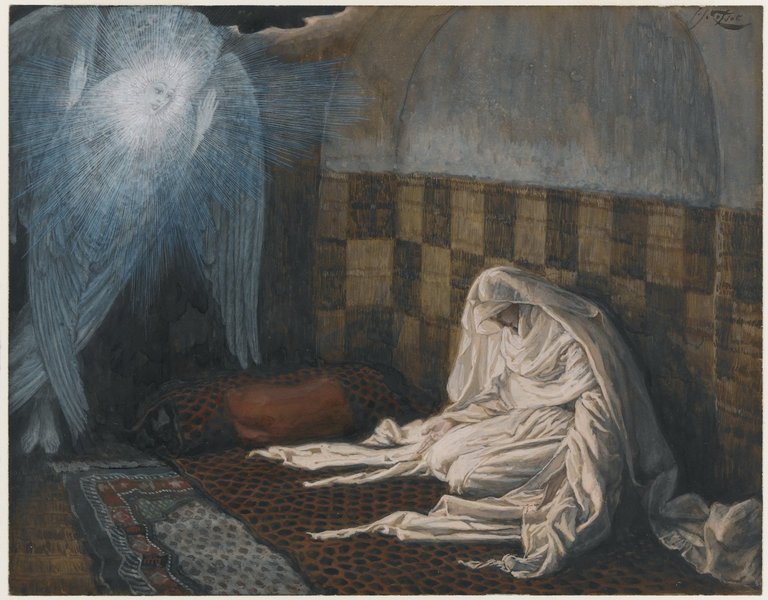
      The Annunciation/ Tissot
    • Ps 40:7-11  "Here I am, Lord; I come to do your will."  You wanted obedience, not sacrifice.  I delight in doing your will.  I announced your justice, faithfulness, kindness, and truth.
    • Heb 10:4-10  Bull/goat blood doesn't take away sins.  He says, “You didn't want sacrifices,” then, “I come to do your will,” taking away the first to establish the second.  We've been consecrated through the offering of the Body of Jesus.
    • Lk 1:26-38  God sent Gabriel to Mary betrothed to Joseph:  “Fear not; you'll bear a great son, Jesus, Son of the Most High, to rule forever.” / “How?” / “The Holy Spirit will come upon you....  'Barren' Elizabeth has also conceived; nothing will be impossible for God.” / “OK; I'm the Lord's handmaid.”
    Reflect
    • Poem:  Annunciation/ Levertov; link includes the last 18 lines, usually omitted.
      Study for the Annunciation/ Tanner
    • Creighton:  The mystery of Incarnation is consciousness of the process of salvation, by which God brings creation out of nothing, life from death, love from hate, and fullness from emptiness. The Church’s recognition that Incarnation is the process of salvation is clear in the “beginning” character of today's celebration:  Jesus’ conception date (we celebrate his birth 9 months later :-) and the gospel of the invitation to a young Jewish girl to partner with God by conceiving and bearing Jesus.  Mary's knowledge of Israel's experience of God and her deep trust of God helped her to say yes.  King Ahaz might have been aware of God’s past care but was unwilling to risk the future based on it.  By refusing to trust, he put God’s plan at risk!  Dare I trust God to guide me toward decisions that will serve his work in my life and in the Kingdom of God?  Pope Francis asks us to trust in the Spirit and learn God's desire.  We're called to embrace how God has cared for us and to embrace a future of possibilities that will reveal God’s victory.  Dare I look at what I'm afraid of and risk discovering how to be incarnational?  Dare I say yes to God like Mary did?
    • One Bread, One Body:  "The people of the Incarnation":  When God became man, it became possible for him to die, and dying made it possible for him to rise and so save us.  So God's Incarnation is the beginning of the greatest events in history; this is why we count years starting from the Incarnation (AD).  We recall Jesus' Incarnation when we pray the Angelus.  We recall the Annunciation of his Incarnation when we pray the Hail Mary and the first joyful mystery of the rosary.  We also celebrate the Incarnation in the Christmas season.  We're the people of the Incarnation; we receive God incarnate whenever we receive Communion.  With Mary, may each of us say with our life, "I am the Lord's handmaid.  Let it be done to me according to your word."
    • Passionist:  Mary is Theotokos, 'God-bearer.'  She agreed to something she didn’t understand.  She did understand the overshadowing ways God works. As Moses couldn't see God “face to face,” she said yes to a power and hope she couldn’t imagine.  God can still work in cloudy, overshadowing ways....
    • DailyScripture.net:  "You have found favor with God":  "Show me a sign of Your favor."  God performed many signs to demonstrate his love and mercy, such as deliverance from slavery and the crossing of the Red Sea.  When King Ahaz was surrounded by forces threatening to destroy him and his people, God offered him a sign to reassure him God wouldn't abandon his promise to David and his descendants, but the king had lost hope and refused to ask for a sign.  God nonetheless gave a sign to assure his people he'd give them a Savior who'd rule with justice and peace.  We see the fulfillment of that prophecy and the unfolding of God's saving plan in the events leading to the Incarnation and the birth of the Messiah, beginning with the miraculous conception of Jesus by the Holy Spirit's action on Mary.  As Eve was the mother of humanity doomed to sin, Mary becomes the mother of the new Adam, father of a new humanity by grace, fulfillment of God's promises.  The angel tells Mary, daughter of the house of David, the promise made to David.  When Mary heard God's message through Gabriel, she knew it was beyond human capability.  Her question wasn't out of doubt but wonder; she responded with faith, believing God's promises, impossible as they seemed.  She was willing and eager to do God's will, difficult as it seemed.  God gives us grace and expects us to respond with the same willingness, obedience, and trust; he gives us the help, strength, and means.  May we yield to his grace....
    Dress legend
    • "Happy birthday, Jesus" pin:  "Ahaz, ask for a sign" (1st reading) [today's tie trumped my 'signs' tie]; Annunciation led to Jesus' birth (gospel)
      • 'Hearts' suspenders:  Your law is in my heart (psalm)
      • 'Blood drop' pin:  Bull or goat blood can't take away sins (2nd reading)
      • 'Scroll' pin:  "In the scroll it's prescribed that I do your will" (psalm, 2nd reading)
      • 'Dove' pin:  The Holy Spirit conceived Jesus (gospel)
      • Blue tie with crowns:  'Blessed Mother blue' (gospel); God will give Jesus the throne of David (gospel)
      • 'Angel,' 'Mary' pins:  Gabriel's annunciation to Mary (gospel)
      • 'Question mark' tie pin:  "How can this be?" (gospel)
      • "No-'L'" pin:  Gospel is from Luke's infancy narrative
      • 'Phone' tie bar:  God's 'call' to Mary through Gabriel
      • White shirt:  Today's liturgical color

      March 24, 2017

      March 24

      March 24, 2017:  Friday, 3rd week, Lent

      See 18 connections with today?
      Legend below

      Listen to music for the 1st reading, plus a psalm setting

      • Hosea/ Norbet, composer-sung
      Pope Francis Thursday homily
      When we don't listen to the Lord, we end up moving away, turning our backs, listening to other voices, idols' voices.  Eventually we become deaf to God's Word.  If we look at our hearts, we'll see how often we close our ears.  When a community becomes deaf to the Lord, they search for other voices, other lords, idols, and distance themselves from God.
      If our heart hardens, we become “Catholic pagans,” “Catholic atheists.”  As we move away from the Lord, our hearts harden.  If I don't listen, my heart closes, unable to receive anything, and I live in that world that does me no good and move further from God.  Deafness to God's Word and a hardened, closed heart cause infidelity.  You lose your sense of fidelity and become unfaithful because you have no reference to God's love.


      The infidelity ends in confusion:  you don't know where God is; you confuse God with the devil as in today's gospel.  Ask, "Do I listen to God, or harden my heart?"  That's blasphemy, the end of the path that begins with not listening, hardening of the heart.  This makes you forget fidelity and, ultimately, blaspheme.  Ask, "Have I stopped listening to the Word of God, taking the Bible into my hands, and talk only to myself?  Has my heart been hardened?  Am I far from the Lord?  Have I lost my fidelity?  Do I live with the idols that offer me worldliness?  Have I lost the joy of the wonder of my first meeting with Jesus?"  "Listen to his voice!  Harden not your hearts!’’  Lord, give us the grace to listen...

      Read
      • Hos 14:2-10  Return to the Lord, your God; you've collapsed through your guilt.  Say, “Forgive all iniquity.  We'll no longer say, ‘Our god’ to the work of our hands.”  God:  "I'll heal their defection, I'll love them freely; my wrath is turned away from them.  Israel shall strike root and put forth shoots in splendor.  They shall dwell in his shade, raise grain, blossom, and have fame.  I've humbled Ephraim but will prosper him.  Because of me you bear fruit!  Let the wise know and understand these things.  The just walk in the Lord's straight paths, but sinners stumble.
      • Ps 81:6c-11ab, 14, 17  "I am the Lord your God: hear my voice."  “I relieved him of the burden.  You called, and I rescued you.  I'll admonish you; won't you  hear me?”  “Don't worship any alien god.  I led you from Egypt.”  “If you hear me and walk in my ways, I'll feed you with the best of wheat and fill you with honey.”
      • Mk 12:28-34  Scribe/Jesus:  “Which is the first of the commandments?” / “God alone is Lord!  Love the Lord with your heart, soul, mind, and strength.  The second:  Love your neighbor as yourself.  No commandment is greater.” / “Well said.  You're right to say, There is no other.  To love him with heart, understanding, and strength, and to love your neighbor as yourself is worth more than all sacrifices.” / “You're not far from the Kingdom.”  No one dared to ask him more questions.
      Reflect
        • Creighton:  "Ours for the asking":  God insists: you are made for love of God, neighbor, and self.  Who/what functions as God in my life?   What gospel do I live by?  How am I saved?  "Return to the Lord..."
        • One Bread, One Body:  "Uninhibited love":  The Lord wants to love us freely, but many aren't open to his love.  Sin makes us afraid of the consuming fire of God's love, so the Lord must heal our sinful defection.  God, Love, clears away our sins, convicting us of them, assuring us Jesus is "an Offering for our sins...," commanding us to repent and confess our sins, and delegating the apostles' successors to forgive sins in his name.  May we be immersed in repentance and plunge into God's love....

        • Passionist:  "Turn to God" occurs 37 times in Scripture; Hebrew suv (turn, face, often translated 'repent') 1050 times!  It summarizes spiritual life.  The Lord is the sun we turn to to grow; to flower we must bask in the light of Christ.  Scripture expresses facing Christ in different ways:  come to him (literally pauo (rest) ana (up) as for another day of work; in Mt people come to him or he to them over 100 times.  “He had healed many; all who had afflictions pressed (ĕpipiptō, fell upon, crushed) around him to touch him.”  Prayer is an unpretentious way of turning or repenting.  In prayer may we touch the human and divine Christ.
        • DailyScripture.net:  "You're not far from God's kingdom":  Hosea's people, living in fear and economic anxiety, were tempted to put their security in their possessions and political alliances.  Hosea called them return to God for pardon, healing, and restoration.  God brings strength and blessing to those who obey him.  Jesus startled the Pharisees with his profound simplicity and mastery of God's law and purpose.  Love as God loves!  The more we know of God's love and truth, the more we love what he loves and reject what's contrary to his will, and the more we believe and hope in his promises.  The Lord, through the Holy Spirit, gives us freedom to love.  What keeps me from the love of God and joy of generous service?
        Dress legend
        • 'Horse' tie pin:  We won't have horses to mount (1st reading)
        • 'Words' tie:  Take with you words, and return to the Lord (1st reading)
        • 'Fruit' pin:  Because of me you bear fruit (1st reading)
        • White tie pin:  Israel shall blossom like the lily (1st reading)
        • 'Straight line' tie bar:  Straight are the Lord's paths....  (1st reading)
        • 'Hands' pin:  We won't say ‘Our god’ to the work of our hands (1st reading); his hands were freed from the basket (psalm)
        • 'Tree' pin:  He shall strike root like the Lebanon cedar; his splendor shall be like the olive tree. I'm like a verdant cypress... (1st reading)
        • 'Owl' tie pin:  Let the wise understand these things (1st reading)
        • 'Phone' tie bar:  You 'called' in distress, and I rescued you (psalm)
        • 'Wheat' pin, "bees' knees" button, 'rock' tie pin:  If you'd hear me and walk in my ways, I'd feed you with the best of wheat and fill you with honey from the rock. (psalm)
        • '?' pin, 'scroll' pin:  “Which is the first of all the commandments?” (gospel)
        • 'Heart' pin:  Love the Lord with all your heart... (gospel)
        • 'Fire' pin:  To love God is worth more than all burnt offerings...  (gospel)
        • Blue shirt:  I tested you at the waters of Meribah (psalm)
        • 'Scales' pin (fell off last week?  Please ask for "Holy Tony"'s help in recovering it):  God's judgment shines forth (1st reading, gospel); Pharisee judges tax collector (gospel)
        • Purple suspenders:  Lenten season