April 25, 2018

Mark

April 25, 2018:  St. Mark, Evangelist

See over a dozen connections with today?
Legend below
Listen
For Psalm 89
Pope Francis
General audience:  Those who request Baptism have responded to the Gospel which has prompted them to believe, have learned how to listen to Jesus, and experience the Samaritan woman's thirst.  Their eyes are opened like the blind man; they rise like Lazarus.  The Litany of the Saints expresses that the whole Church accompanies them.  The exorcism and anointing with the oil of catechumens assure those preparing for Baptism that the Church's prayer assists them in the fight against evil.
Jesus fought and cast out demons to show God's kingdom had come.  His victory is a sign of his lordship.  Through the gift of Baptism, Jesus gives us the ability to fight evil.  The candidates receive a second anointing; fighters used to cover themselves with oil to tone their muscles and more easily escape the enemy’s grasp.  Christian life is a tiring struggle against evil, but we're accompanied by Mother Church who prays that her children conquer it by Christ's power:  “I can do all things in him who strengthens me.”
Post-audience:  The upcoming Inter-Korean Summit is an opportunity to start dialogue leading to reconciliation and union, to guarantee peace.  May those with political responsibilities have the courage of hope making themselves artisans of peace continuing on the path begun for the good of all.
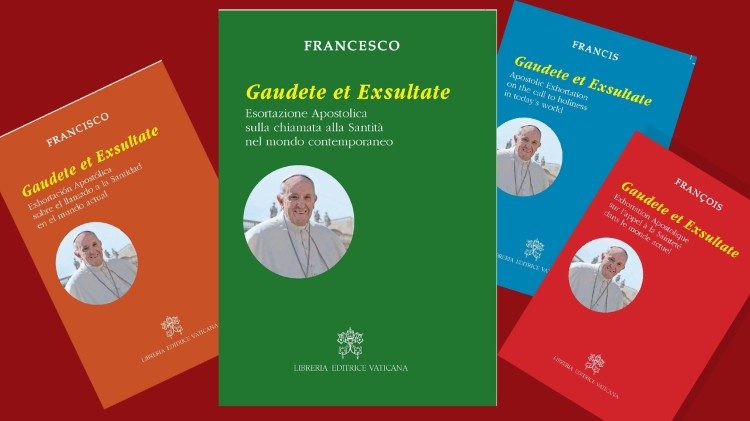
Gaudete et exsultate nugget:  In the light of the Master
There can be any number of theories about what constitutes holiness, with various explanations and distinctions. Such reflection may be useful, but nothing is more enlightening than turning to Jesus’ words and seeing his way of teaching the truth. Jesus explained with great simplicity what it means to be holy when he gave us the Beatitudes (cf. Mt 5:3-12; Lk 6:20-23). The Beatitudes are like a Christian’s identity card. So if anyone asks: “What must one do to be a good Christian?”, the answer is clear. We have to do, each in our own way, what Jesus told us in the Sermon on the Mount.[Homily 9 June 2014] In the Beatitudes, we find a portrait of the Master, which we are called to reflect in our daily lives.
The word “happy” or “blessed” thus becomes a synonym for “holy”. It expresses the fact that those faithful to God and his word, by their self-giving, gain true happiness. [63-64]
Read
  • 1 Pt 5:5b-14  Clothe yourselves with humility; humble yourselves under God's mighty hand.  Cast your worries on him; he cares for you.  Be sober and vigilant.  Resist the devil.  God who called you will restore and strengthen you.  Remain firm in God's grace.  Greet each other with a loving kiss.  Peace to you all!
  • Ps 89:2-3, 6-7, 16-17  "For ever I will sing the goodness of the Lord."  I'll proclaim your faithfulness.  The heavens proclaim your wonders and your faithfulness....
  • Mk 16:15-20  Jesus to the Eleven:  "Go proclaim the Gospel to every creature.  Whoever believes and is baptized will be saved.  These signs will accompany believers:  they'll drive out demons, speak new languages, pick up serpents, lay hands on and heal the sick...."  Then he was taken up into heaven and took his seat at God's right hand.  They preached everywhere, while the Lord worked with them....
Reflect
  • Creighton:  "Watching with one another":  The words “Be sober and vigilant” remind us that Christian life provides no immunity from struggles.  Those who consider the good news of Jesus’ resurrection as “bad news” can persecute believers; just as Jesus was rejected, so will we be.  Shall we live sobriety and vigilance alone, in fear, with hand-wringing?  No; in solidarity:  “Your brothers and sisters are also suffering.”  Perhaps those experiencing the consolation of faith might pray for those suffering harassment or persecution.  The suffering might pray to receive consolation through their brothers and sisters' prayers....
  • One Bread, One Body:  "Making your Mark":  The early Church, and Mark, tried to proclaim the Gospel to the world, using every means available to them: walking, meetings in public places, synagogues, the Temple, and homes....  Mark, AKA John and John Mark, was part of the first missionary journey.  Trying to permeate the culture with the Gospel (Catechism 899), he found a new way to share the Good News:  the written word, a Gospel narrative.  People still read his gospel and give their lives to Jesus; many are in heaven thanks to his innovation and dedication.  Today there are many ways to communicate that didn't exist in Mark's time:  social media, websites, email, txt....  But traditional person-to-person contact is still the most effective way to reach a heart.  May you discover a lasting means to reach many with the Good News.
    St. Mark/ Theophilia
  • Passionist:  Mark ended his gospel with the empty tomb.  People of faith must write and live their own conclusion.  We preach Christ crucified, take up our cross, and become disciples on mission, proclaiming the resurrection.  Bear all that's unresolved in your heart, trying to love the questions themselves.  If you live the questions now, you'll gradually live into the answer.
  • DailyScripture.net:  "Go and preach the gospel to all creation":  All four gospels proclaim the good news of Jesus Christ, Savior of the world; Mark's is the shortest and likely earliest, likely written in Rome, likely written for Gentiles, especially Rome Christians.  "The Spirit willed to choose for the writing of the Gospel two [Mark and Luke] who were not even from the Twelve, so it might not be thought that the grace of evangelization had come only to the apostles" (Augustine, Sermon 239).  Mark ends his account with Jesus' last appearance to the apostles before his ascension.  Jesus' departure and ascension were an end and a beginning for his disciples:  the end of his physical presence with them, the beginning of his presence with them through the Spirit.  Jesus' last words to them point to their mission to be witnesses of his death and resurrection and to proclaim the good news.  God's love and salvation are for the whole world.  The gospel is God's power to forgive, heal, deliver, and to restore life.  All believers are to be heralds of the good news and ambassadors for Christ; the Lord works in and through us by the Spirit's power.
  • Universalis:  Mark, cousin of Barnabas, disciple of Peter, accompanied Paul on his first missionary journey, followed him to Rome, founded the Church in Alexandria.   His gospel is told from Peter’s point of view. See also Wikipedia.
Dress legend
  • 'Hands' pin:  "Humble yourselves under God's mighty hand" (1st reading); "Believers will lay hands on the sick, who will recover"; Jesus took his seat at God's right hand (gospel)
  • 'Lion' pin:  "Your opponent the Devil is prowling around like a roaring lion" (1st reading); symbol of Mark the Evangelist and of Jesus' resurrection
  • 'Peace sign" tie bar:  "Peace to all you who are in Christ." (1st reading)
  • 'International stamps' tie:  "Go into the whole world and proclaim the Gospel" (gospel)
  • 'Sign' pin:  "These signs will accompany believers:..." (gospel)
  • 'Phone' tie bar:  God 'called' you to his glory... (1st reading)
  • 'Car with mouth' tie pin:  "Greet one another with a loving kiss" (1st reading); "believers will 'drive' out demons,..." (gospel)
  • 'Serpent' tie pin:  "...pick up serpents..." (gospel)
  • Red on tie:  Liturgical color for St. Mark feast
  • White in shirt and socks:  Easter season

April 24, 2018

April 24

April 24, 2018:  Tuesday, 4th week, Easter

See more than a dozen connections with today?
Legend below
Listen

"Good Shepherd" music
Pope Francis
Homily:  The close-minded observance of the doctors of the Law became rigidity.  They placed themselves at the center, untouched before the Spirit's work.  Their inability to discern the signs of the times was a type of prison:  they received a law that was life but “distilled” it, transforming it into an ideology they couldn't move beyond.  Anything new for them was a threat.
The opposite is true of the child of God for whom the Spirit is central.  The first disciples' docility before what was new to them led them to sow God's Word in new ways.  They remained docile to the Spirit and accomplished more than a revolution:  they put the Church in motion.  A Church, like a bicycle, can only achieve its balance when in motion.
A person can either be closed or open to the Holy Spirit.  The disciples and apostles were open, but there will always be resistance to the Spirit.  Lord, grant us the grace of knowing how to resist those we must resist, those who come from the evil one, those who deprive us of freedom.  May we open ourselves to the new things that come from you.  Give us the grace to discern the signs of the times in order to make the decisions we need to make.
Gaudete et exsultate nugget:  The summation of the Law:  A hierarchy of virtues bids us seek what's essential.  The primacy belongs to the theological virtues, which have God as their object and motive.  At the center is charity.  What counts is “faith working through love.”  “The one who loves another has fulfilled the law…”  “The whole law is summed up in, 'Love your neighbor as yourself.'”

Amid precepts and prescriptions, Jesus clears a way to seeing two faces, the Father's and our brother's, or better yet, one:  God's, reflected in others, especially the least, most vulnerable, defenseless and needy.  The Lord will shape his final work of art with the scraps of our frail humanity.  “What endures, what has value, what riches don't disappear?  The Lord and our neighbor” [11-13-16].

May the Lord set the Church free from these new forms of gnosticism and pelagianism that block her path to holiness!  Reflect and discern whether they may be present in your life. [60-62]
Read

  • Acts 11:19-26  The disciples scattered by the persecution were preaching only to Jews, some among them started proclaiming Jesus to Greeks too.  Many turned to the Lord.  When Barnabas arrived at Antioch, he rejoiced and encouraged them to remain faithful; then he brought Saul from Tarsus to Antioch, where they taught for a year.
  • Ps 87:1b-7  "All you nations, praise the Lord."  Glorious things are said of you, O city of God!
  • Jn 10:22-30  Jews gathered around Jesus and said, “If you're the Christ, tell us.”  Jesus answered them, “I told you and my works testify, but you don't believe because you're not my sheep.  They hear my voice and follow me; I give them life, and they'll never perish.  The Father and I are one.”
Reflect
  • Fr. Jose Rueda homily video:  Jesus Christ: teacher, prophet, priest, mediator, healer, sanctifier, miracle worker, king, good shepherd
  • Creighton:  John's gospel focuses on Jewish feasts, especially Passover and Tabernacles (Booths).  Feasts are part of John’s symbolic world, helping illuminate the reality of Jesus as fulfillment of Jewish tradition.  The “feast of the Dedication [Renewal]” is Hanukkah, a commemoration of the Jews' successful rebellion against Antiochus Epiphanes IV, who was trying to stamp out what was distinctive about his Jewish subjects.  The Maccabean revolt enabled the Jews to reclaim the temple and their autonomy (till the Romans' conquest).  The celebration encouraged speculation about whether Jesus was the Messiah.  John’s mention of the feast and the name Solomon (son of David who reigned over the largest expansion of Israel) evokes what people were thinking.  When Jesus’ adversaries challenged him to identify himself as Messiah, Jesus said he saw himself as a shepherd, whose flock is those who accept him.  The vision of Ez 34 pictures another “David” who will shepherd Israel, find, heal, and feed the lost, in contrast to self-serving, abusive false leaders.  Ezekiel says God will be the true shepherd; hence the power of Jesus’ “The Father and I are one.”
In a narrative where Jesus had referred to himself as God's temple, readers would note this happens in the temple, already destroyed by the Romans.  Knowing Jesus as Lord, they knew he embodied what the temple stood for:  the “place” of God's presence, the “tenting” of God's Word among us, as John proclaims.  We believe the risen Jesus really is our shepherd who fulfills the vision of Ez 34:  not just consoler and protector of the shepherd figure but healer and leader who continues to gather God's scattered children, the ultimate leader we trust through troubled times.
  • One Bread, One Body:  "The 'look' of selfless love":  Disciples of Christ are tempted to do it all themselves, but Barnabas realized he needed help teaching Christians at Antioch.  Knowing that Saul had the needed gifts, he took the time to look for him.  Once he found him, "he brought him to Antioch.  For a year they instructed great numbers."  From there, the new church sent Barnabas and Saul on the first Christian missionary journey.  Barnabas did what was needed to bring full life to the Antioch Christians. If someone could help you in your ministry, would you ask them?  Would you seek them out at your expense?
    Christ, the Good Shepherd/ Murillo
  • Passionist:  Today's gospel enlightens us about prayer: “My sheep hear my voice, I know them, and they follow me.”  One of the first steps of communicating with God is to let him speak.  All good communication starts with listening.  Scripture contain “God's living and highly energetic Word.”  If we're serious about listening to God, we should have passionate interest in his Word!  Listening to it leads to intimacy with him, people asked Jesus, “How long are you going to keep us in suspense (Gk airo, air)?”  Without a strong prayer life, we're unlikely to know Jesus.  Most “grievously neglect the sacred and divine work of prayer.  We must listen attentively to God's Voice.  Prayer is intimacy with God” (Gregory of Nyssa).
The gospel says, “they follow me”; discipleship is often expressed as following Christ.  To follow someone, you need to be close.  Scripture also uses 'walk,' as in "Will you also walk away?"  Don't to walk away from Christ; “pray always so you're not left in bad way!”
  • DailyScripture.net:  "My sheep hear my voice":  Jesus speaks of his trust in his Father and the trust we should have because he's our Good Shepherd.  Sheep without a shepherd are defenseless and often get lost, so shepherds live with their sheep, guard them from danger, and lead them to food, drink, and rest.  The sheep recognize and heed their shepherd's voice.  We're like sheep who stray, becoming prey to forces that can destroy us.  Jesus came to free us from the grip of sin and to lead us to places where we can feed on his "word of life" and drink from the "living waters" of his Spirit.  Sheep who heed the Good Shepherd need not fear; he leads them to peace, joy, and fellowship with God and his people.  We can face our difficulties alone or can follow Jesus.  Today's gospel takes place during the Feast of the Dedication (Festival of Lights, Hanukkah), at which time Jesus also declared he is the Light of the World, in whom we can see God and find the path to heaven."
  • 'Dove' pin:  Disciples were docile to the Spirit; Barnabas was Spirit-filled. (1st reading)
  • 'Abacus' tie pin:  A large number was 'added' to the Lord (1st reading)
  • 'Heart' pin:  Barnabas encouraged them to remain firm of heart (1st reading)
  • 'Olympics' tie pin:  All you nations, praise the Lord (psalm)
  • 'Alps' tie pin:  The Lord loves his foundation on the holy mountains (psalm)
  • 'Hand' tie pin:  The Lord's hand was with them (1st reading); no one can take my sheep out of my hand (gospel)
  • '?' tie pin:  "How long are you going to keep us in suspense?" (gospel)
  • 'Good Shepherd' tie, 'sheep' tie bar:  "My sheep hear my voice... and follow me" (gospel)
  • Green, blue, and white shirt; white socks:  Verdant pastures and restful waters (Ps 23:2, Good Shepherd gospel-inspired), Easter season

April 23, 2018

April 23

April 23, 2018:  Monday, 4th week, Easter

See over a dozen connections with today?
Legend below
Listen

For Psalms 42-43

  • Sicut cervus/ Palestrinaabout, including English text
  • My soul thirsts/ Schutte: non-Spotify excerpt, buy
  • Like the deer/ Schutte
  • Pope Francis
    Regina CÅ“li:  Today's readings help us rediscover our identity as disciples of the Risen Lord.  Peter declared the cripple's healing was accomplished in Jesus' Name, and salvation is through Jesus alone.  We see ourselves and our communities in the healed man.  We can all be healed if we put ourselves in the Risen Lord's hands.
    Who is the Christ who heals?  The good shepherd, who laid down his life for the sheep, who offered offered his life for us.  The gospel goes on to show the relationship that must exist between us and the Lord:  “I know my own, and my own know me.”  This knowledge is a personal relationship of love.  Jesus knows us intimately, and we're called to know him.  That implies an encounter with him, who gives us the desire to follow him along new paths.  If our desire to follow Jesus cools, we'll fall into ways of thinking and living not consistent with the Gospel.
    Gaudete et exsultate nugget:  New pelagians:  Some Christians insist on taking the path of justification by their own efforts, worshiping the will and their abilities; the result is loveless, self-centered, elitist complacency.  Maybe they're obsessed with the law, absorbed with social and political advantages or prestige, punctiliously concerned with liturgy and doctrine....  Let yourself be led in love by the Spirit.  Communicate the beauty and joy of the Gospel, and seek out those thirsting for Christ [EG 95].

    If Christians give excessive importance to certain rules or customs, the life of the Church can become a museum piece or the possession of a select few, and the gospel can be constricted, deprived of simplicity and allure.  This may be a form of pelagianism, subjecting the life of grace to human structures.  It can fossilize a movement and community that began with an intense life in the Spirit.

    Once we believe everything depends on our effort as channeled by ecclesial rules and structures, we complicate the Gospel and become enslaved to a blueprint that leaves little room for grace.  Precepts the Church adds to the Gospel should be imposed with moderation lest our religion become a form of servitude [ST I-II q107 a4]. [57-59]
    Read
    • Acts 11:1-18  Jews / Peter:  ‘You ate with the uncircumcised.” / “Three times I had a vision of a sheet from the sky with animals on it, heard ‘Slaughter and eat,’ said, ‘No; nothing unclean has entered my mouth,’ and heard ‘Don't call profane what God has made clean’; then everything returned to the sky.  Three men appeared; the Spirit told me to accompany them.  One said an angel directed, ‘Summon Peter; he'll speak saving words to you.’  As I spoke, the Spirit fell on them.  If God gave them the gift he gave us, who was I to get in the way?” / “God has granted life to the Gentiles too.”
    • Ps 42:2-3; 43:3-4  "Athirst is my soul for the living God."  Send your light and fidelity to lead me, and I'll go to God's altar and thank you!
    • Jn 10:1-10  “Whoever enters through the gate is the shepherd.  The sheep hear his voice, as he calls his own by name and leads them.  He walks ahead of them, and they follow him because they recognize his voice.  I am the gate.  Whoever enters through me will be saved and find pasture.  A thief comes to steal and destroy; I came so that they might have life and have it more abundantly.”
    Reflect
    • Creighton:  The parable focuses on the shepherd, the explanation on Jesus as shepherd and gate.  The shepherd has an other-centered attitude toward the sheep.  Unlike the intruder, he seeks their good.  Just as each of us is “my brother’s keeper,” so too are we their shepherds.  We "lead" others by our words and actions, so we must we foster other-centeredness, asking not “What’s in it for me?” but rather “What’s in me for it?”
    The sheep trust the shepherd:  they know his voice, each feels addressed when the shepherd calls.  How familiar are we with our Shepherd?  When we face a decision, do we ask “What does God want of me?” or “What do you want of me, Lord?”, as Paul did?  Instead of asking WWJD, ask WWYD.  May we grow in this second-person rapport with the Shepherd, so we may recognize and hear his call.
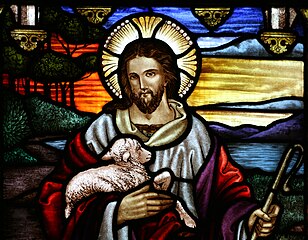
      "I am the Good Shepherd"
      (St. John the Baptist Anglican Church)
    • One Bread, One Body:  "Without hindrance":  Peter asks: "Who was I to hinder God?"  We should ask the same.  How have we hindered God's work?  God has placed you in a unique situation on earth.  No one has the same influence on your family, parish, workplace, school, etc. as you.  The Lord has special plans to accomplish his will through you.  You can hinder, help, or hasten it.  God can work all things to the good despite you, but he wants to work through you because of your obedience and joyful service.  His will be done.
    • DailyScripture.net:  "I came that they may have life abundantly":  The Old Testament speaks of God as shepherd of his people:  "The Lord is my shepherd."  "Give ear, O Shepherd of Israel."  "We are the sheep of his pasture."  The Messiah is pictured as the shepherd of God's people:  "He will feed his flock like a shepherd."  Jesus is the Good Shepherd who will risk his life for the stray sheep; he is our Shepherd and Guardian.
    The Good Shepherd

    (St. Anthony's Monastery)
    At day's end shepherds brought their sheep into shelter.  Sheep know their shepherd's voice and come at his call.  Each is called by name.  In winter sheep were brought to a communal shelter a guardian kept secure; in summer they were kept in fields then gathered at night into a fold guarded by a shepherd, the door they had to pass through.
    God is a shepherd who brings his people security and peace.  "The Lord will keep your going and your coming forever."  Leaders are called shepherds:  they'll lead them out and bring them in, that the Lord's people not be as sheep without a shepherd.  As a shepherd watches and protects his sheep, so Jesus watches us as our Shepherd and Guardian.  Jesus laid down his life for his sheep, that he might change his body and blood into food, and nourish the sheep he redeemed.  He showed us the way.  We must use our goods in mercy for his sheep's needs, even giving our life. (St. Augustine, Homilies on the Gospel of John, tractate 46, paraphrased).
    Dress legend
    • 'Eyeball' tie pin:  Peter's vision:... (1st reading)
    • 'Animals' tie:  "I saw the animals of the earth, wild beasts, reptiles, birds..." (1st reading)
    • 'Angel' pin:  "I saw an angel telling me to summon Peter..." (1st reading)
    • 'Dove' pin:  The Spirit directed Peter; the Spirit fell on the Gentiles (1st reading)
    • 'Deer' tie pin:  "I long for God as the deer longs for water" (psalm)
    • 'Piano' (stringed instrument) pin:  I'll give you thanks on the harp (stringed instrument) (psalm)
    • 'Street light' tie bar:  Send your light and your fidelity;... (psalm)
    • 'Alps' tie pin:  ...They'll lead me to your holy mountain, your dwelling (psalm)
    • 'Sheep' tie bar:  The sheep hear the voice of the shepherd, who lays down his life for them (gospel)
    • 'Phone' tie bar:  He 'calls' his sheep by name (gospel)
    • 'Car' pin:  When the shepherd has 'driven' out all his own,... (gospel)
    • Walker/runner:  ...he walks ahead of them.  They follow him, but they'd run from a stranger (gospel)
    • Red and white shirt:  Red for "slaughter and eat" (1st reading), white for Easter season

    April 22, 2018

    Good Shepherd Sun.

    April 22, 2018:  Fourth Sunday of Easter
    Good Shepherd Sunday

    See a dozen connections with today?Legend below
    Listen
    For Psalm 23 (apropos though not one of today's readings)
    For Psalm 118 (today's actual psalm)
    From Ed Bolduc's blog
    For future Sundays...

    Pope Francis 

    To new priests:  Don't tire of being merciful.  Think of your sins that Jesus has pardoned.  May your teaching nourish God's People and your life be joy and support to the faithful.  May your word and example edify the Church.  Be intent on pleasing God alone, rather than yourself or others, or seeking other interests.  Be concerned only with service to God, for the good of the faithful.
    World Day of Vocations messageGod's call to joy is at the center of our life; it's God’s plan for people in every age.  Our life and our presence in this world are the fruit of a divine vocation!  God-with-us continually comes to encounter us, walking along the often dusty paths of our lives.  He knows our longing for love and calls us to joy.  Each of us needs to listen, discern and live God's call to us, develop our talents, and be instruments of salvation.  Listening, discerning, and living were also present at the start of Jesus’ own mission:  he listened to the word, discerned the content of the mission the Father entrusted to him, and proclaimed that he came to accomplish it.
    Listen:  We can't hear the Lord as clearly as other things in our daily experience; he comes silently and discreetly; our worries can drown him out.  We need to learn to listen to him and the story of his life and to be attentive to the details of our own lives, to learn how to see with the eyes of faith and stay open to the Spirit.  We'll never hear God's special, personal call if we stay enclosed in our routine, in our own little world, in apathy; we'd lose the chance to dream and to play our part in the story God wants to write with us.  Jesus was called and sent; he needed silence to listen to and read the word in the synagogue and reveal its meaning, with reference to himself and the history of Israel.
    Our noise-filled society bombarded by information makes listening harder, and inner confusion often accompanies the outer noise.  This prevents us from enjoying contemplation, reflecting on events of our lives, working confident in God’s plan, and discerning fruitfully.  God's kingdom comes quietly and unobtrusively; we can only gather its seeds when we're open to the whisper of the divine breeze.
    Discern:  When Jesus read from Isaiah, he discerned his mission and presented it to those who awaited the Messiah:  "to bring good news to the poor, proclaim release to captives and recovery of sight to the blind, let the oppressed go free, and proclaim the Lord’s favor."  We can only discover our vocation through discernment, in dialogue with the Lord, listening to the Spirit.
    Christian vocation always has a prophetic dimension.  The prophets were sent to the people in situations of insecurity and crisis to address God’s message of conversion, hope, and consolation.  Prophets discern events in the light of God's promise, unsettle the false tranquility of consciences that forget the Lord's word, and enable people to see dawn amid dark shadows.  We need discernment and prophecy.  We must resist the temptations of ideology and negativity and discover how God calls us.  We ought to grow in the ability to “read within” our lives and understand what the Lord is calling us to, so we may carry out our mission.
    Live:  Jesus announced the newness of the present; it enthused many but hardened others' hearts.  He's the is the Messiah anointed to liberate prisoners, restore sight, and proclaim God's love.  “Today this Scripture has been fulfilled....”  Gospel joy won't abide slowness and sloth; it won't fill us if we keep waiting for the right time, without accepting the risk of making a decision today.  Vocation is today!  Our mission is now!  Each one of us is called–whether to marriage, ordained ministry, or special consecration–to become a witness of the Lord, now.  God continues to “come down” to save our human family and make us sharers in his mission.  He calls others to follow him in a close relationship.  Don't be afraid if he calls you to consecrate yourself totally to his kingdom!  It's beautiful, and a great grace.
    Don't wait to be perfect to answer the Lord's call, or fear your limitations and sins; open your heart to the Lord.  Listen, discern your mission, and live it today.  May Mary, who heard, accepted, and experienced God's Word made flesh, protect us and accompany us always.  Full text

    To Italian pilgrims
    :  
    The memory of Popes Pius VI and Pius VII lead us to reflect on the path of evangelization and missionary goals.  Continue on this path, proclaim the Gospel, and witness it with works.  Christians are leaven of love, fraternity, and hope with daily gestures.  Small gestures can do much good.  Sharing the word and celebrating the Eucharist together fosters fraternity and makes us a holy and missionary community.  The Eucharist makes the Church, brings it together, and unites it in love and hope.
    Open your heart to an encounter with Jesus Christ.  This mission is a responsibility, a joy, a heritage of salvation, and a gift to share; it requires availability, self-denial, and abandonment to God's will, journeying in holiness to respond to the Jesus' call, according to our own charism.
    Gaudete et exsultate nugget:  An often overlooked Church teaching:  We're justified not by our own works or efforts but by God's grace.  God pours into us the source of his gifts even before we enter into battle [John Chrysostom].  The faithful glory in God alone, for “they realize they lack true justice and are justified only through faith” [Basil, Homily on humility].
    Nothing human can demand, merit, or buy grace, and cooperation with it is itself from grace:  “Even the desire to be cleansed comes about through the Spirit” [2nd Synod of Orange 4].  “Nothing that precedes justification, neither faith nor works, merits the grace of justification; for ‘if it is by grace, it is no longer on the basis of works; otherwise, grace would no longer be grace’” [Trent re justification].

    Grace “surpasses the power of intellect and will” [ibid.] and we have no right to merit; between God and us there's an immeasurable inequality [ibid.].  We can't buy his friendship with works; it's from his loving initiative.  This invites us to live in gratitude, since “after one has grace, the grace... can't come under merit” [ST I-II q114 a5].  The saints didn't trust in their own works:  “I'll appear before you empty-handed; I don't ask you to count my works.  All our justices have stains in your sight” [Thérèse, Offering to Merciful Love].

    This truth should affect how we live, for it flows from the Gospel and demands that we make it a source of contagious joy.  We can't celebrate the Lord’s friendship unless we realize our life and abilities are his gift.  We need “to acknowledge jubilantly that our life is essentially a gift, our freedom a grace.  This is not easy....” [Lucio Gera]

    Only when we accept and receive God’s gift can we cooperate by our efforts in our transformation [Catechism].  We must first belong to God, offering ourselves to him and entrusting our abilities, efforts, struggles, and creativity to him, so his gift may grow and develop in us:  “Present your bodies as a living sacrifice, holy and acceptable to God.”  Charity alone makes growth in the life of grace possible:  “If I don't have love, I'm nothing.” [52-56]
    Read
      Good Shepherd/ Plockhorst
    • Acts 4:8-12  Spirit-filled Peter:  “This man was healed in the name of Jesus Christ whom you crucified, whom God raised from the dead.  He's the stone you rejected that's become the cornerstone.  There's no salvation through anyone else.”
    • Ps 118:1, 8-9, 21-23, 26, 28-29  "The stone rejected by the builders has become the cornerstone."  Give thanks to the Lord; his mercy endures forever.  Take refuge in the Lord.  You answered and saved me.
    • 1 Jn 3:1-2  See what love the Father bestowed on us, that we may be called his children.  The world doesn't know us because it didn't know him.  We're God’s children now, and we'll be like him, for we'll see him as he is.
    • Jn 10:11-18  “I am the good shepherd.  A good shepherd lays down his life for the sheep.  A hired man who sees a wolf leaves the sheep and runs away because he has no concern for the sheep.  I know mine and mine know me.   I must also lead sheep not of this fold; they'll hear my voice, and there will be one flock, one shepherd....
    Reflect
    • Creighton:  In Peter's response to questions about the cripple's healing at the temple gate, he focused the leaders' attention not on the deed but that it was done in the name of Jesus, the only Savior.  When we're praised for a job well done, do we take the credit, deflect it to our mentors or teammates, or give praise to our Lord?  When we humble ourselves and give God the praise, it reinforces his presence and guidance in our lives and that the good we try to do is not for our own gain, but for God's glory.  We may be stones the builders rejected, but by our actions we can become cornerstones of God’s church.
    • One Bread, One Body:  "Fill up":  At the first Christian Pentecost, "all were filled with the Spirit."  After Peter and John were released from prison, the first Christian community gathered to pray, and "the place where they were gathered shook as they prayed. They were filled with the Spirit."  Stephen was "filled with faith and the Spirit."  Barnabas was "filled with the Spirit and faith."  "Be filled with the Spirit."  We need to be filled with the Spirit because we may have rationed our reception of the Spirit due to sin, fear, or ignorance; or quenched or grieved the Spirit through sin and selfishness.  The Spirit can change us from petty, narrow, and self-centered to big-hearted and great-souled.  "Receive the Spirit."  "Stir into flame the gift of God:  a Spirit that makes us strong, loving, and wise."
      Good Shepherd/ Ruppert
    • Passionist:  The Good Shepherd image is about the intimate relationship between Jesus and his followers.  We know each other well, call each other by name, feel safe with one another, protect one another, know each other’s voices, and respond almost automatically.  No force can break the bond.  Jesus is the cornerstone of our relationship; all rests on and in him.  The relationship rests on the sacrifice of the cross and the glory of the Resurrection.  “We are God’s children,” loved beyond our imagination.  Does this describe my relationship with the Lord?
    • DailyScripture.net:  The Old Testament speaks of God as shepherd of his people:  "The Lord is my shepherd."  "Give ear, O Shepherd of Israel!"  "We are the sheep of his pasture.  The Messiah is pictured as shepherd:  "He will feed his flock like a shepherd."  Jesus says he is the Good Shepherd who will risk his life to seek out and save the stray; he's the "Shepherd and Guardian of our souls."
    "Jesus shows in what manner a shepherd may be proved good and teaches he must be prepared to give his life defending his sheep.  We departed from God's love, fell into sin, and so were excluded from paradise, and became wolves' prey, but Christ the True Shepherd laid down his life for us, bearing the Cross to destroy death....  He died for us as truly Good, and truly our Shepherd, driving away death so he might join us to the blessed in heaven and grant us mansions in his Father’s house.  He tells us, 'Fear not, little flock, for it has pleased your Father to give you a kingdom.'" (Cyril of Alexandria)
    Dress legend
    • 'Dove' pin:  Peter was filled with the Spirit (1st reading)
    • 'Stone' tie pin:  Jesus, the stone you rejected that's become the cornerstone (1st reading, psalm)
    • 'Boundless mercy' pin:  The Lord's mercy endures forever (psalm)
    • 'Eyeball' tie pin:  It's wonderful in our eyes (psalm); See what love the Father gave us; we'll see God as he is (2nd reading); hirelings who see a wolf coming leave the sheep (gospel)
    • 'Heart' pin:  What love the Father has bestowed on us (2nd reading)
    • 'Good Shepherd' tie:  "I am the good shepherd..." (gospel)
    • 'Sheep' tie bar:  ...who lays down his life for the sheep (gospel)
    • White shirt and socks:  Easter season
    • 'Phone' tie bar:  Respond to God's 'call'; pray for vocations.